
You're Already Using a Scheduling Algorithm. It's Just Running Against You.
Picture this: You spend Sunday reviewing 40 vocabulary words for the English presentation on Wednesday. You feel prepared. Wednesday comes — you blank on half the words mid-sentence.
Or this: You've been using Duolingo every day for six months. You can pass their daily quizzes. But when your tech lead asks you a question in English, you hesitate, stumble, switch back to simpler words.
Here's the uncomfortable truth: your brain is already running a scheduling algorithm on your memories. You just haven't been feeding it the right inputs.
That algorithm decides what to keep and what to delete based on one primary signal: how recently and how often was this information retrieved under effortful conditions?
If the answer is "I crammed it on Sunday" or "I tapped through a Duolingo streak every morning at 7am," the signal is weak. The memory gets garbage-collected.
Spaced repetition is the practice of feeding that algorithm exactly the inputs it needs — review at the right moment, with the right difficulty — so vocabulary compounds instead of decaying.
This is the complete developer's guide to how it works.
What Spaced Repetition Actually Is (The Non-Textbook Definition)
Spaced repetition is a review method that schedules each piece of information for review at the last viable moment before you'd forget it — not on a fixed calendar, not randomly, but precisely timed to your individual memory state for that specific item.
The result: vocabulary reviewed less frequently stays in memory longer than vocabulary reviewed more frequently on a fixed schedule.
That's the paradox at the center of this method, and it's counterintuitive enough that most people don't believe it until they see the data.
Traditional study logic says: review more often → remember better.
Spaced repetition says: review at exactly the right intervals → remember better with a fraction of the time.
Both can't be fully right. The research is unambiguous about which one holds up over 4–8 weeks.
The Mechanism: Why Timing the Review Is Everything
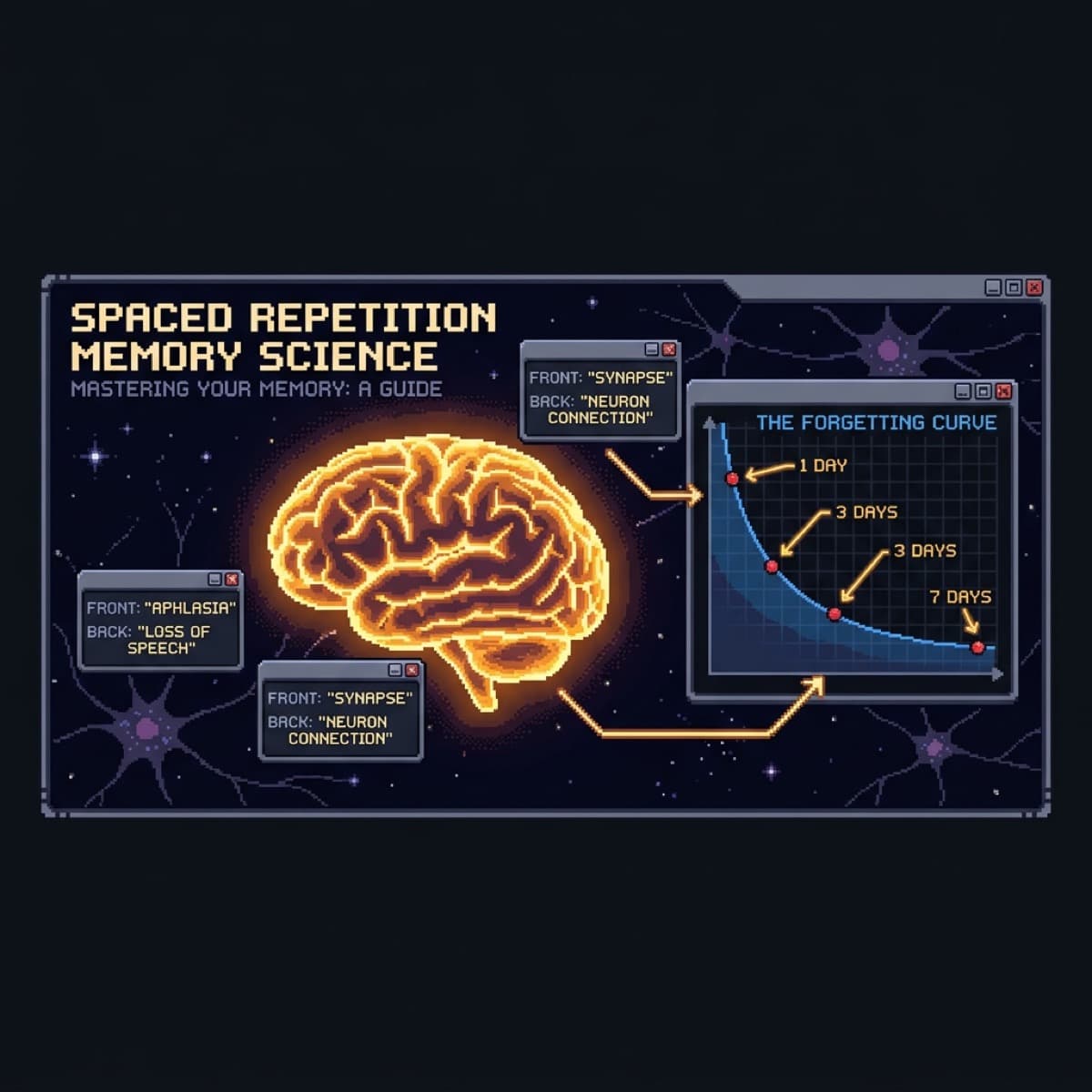
In 1885, Hermann Ebbinghaus conducted the first rigorous study of human memory — testing himself over years on thousands of nonsense syllables. His core finding, now called the Ebbinghaus Forgetting Curve, has been replicated consistently ever since:
Memory decays exponentially over time unless retrieval occurs.
| Time since learning | Memory retained (no review) |
|---|---|
| 20 minutes | ~58% |
| 1 hour | ~44% |
| 24 hours | ~33% |
| 1 week | ~25% |
| 1 month | ~21% |
This decay isn't a flaw. It's the brain's resource management system — aggressively pruning information it has no evidence is important. Your brain treats unreinforced memories as dead code: syntactically valid but never called, so safe to clean up.
Ebbinghaus's second finding is the one that changes the game: each time you successfully retrieve a memory before it fully decays, the forgetting curve resets — but at a shallower slope. The memory becomes more resistant to decay.
This means:
Spaced repetition automates the "right moment" calculation for every word individually. No manual tracking, no guessing. Just a review queue that shows you the right word at the right time.
For a deep technical look at the forgetting curve and code analogies for how memory decay actually works, see The Ebbinghaus Forgetting Curve Explained for Developers →.
The SM-2 Algorithm: How the Intervals Are Actually Calculated
Most spaced repetition apps — including Wordrop — use SM-2 (SuperMemo 2), developed by Piotr Woźniak in 1987. It's the algorithm that powers Anki, SuperMemo, and most serious vocabulary tools.
SM-2 tracks two values per word:
| Property | What it means | Starting value |
|---|---|---|
| Interval (I) | Days until next review | 1 day |
| Ease Factor (EF) | How aggressively the interval multiplies | 2.5 |
After each review, you rate your recall on a 0–5 scale:
| Rating | Meaning | New Interval | EF Change |
|---|---|---|---|
| Again (0) | Complete blank | Reset to 1 day | −0.20 (floor: 1.3) |
| Hard (1) | Recalled with difficulty | ×1.2 | −0.15 |
| Good (3) | Recalled correctly | ×EF | No change |
| Easy (5) | Instant recall | ×EF | +0.10 |
A word rated "Good" consistently with EF = 2.5:
Review 1: Day 1
Review 2: Day 3   (interval × 1)
Review 3: Day 8   (3 × 2.5 = 7.5, rounded)
Review 4: Day 21  (8 × 2.5)
Review 5: Day 53  (21 × 2.5)
Review 6: Day 132 (53 × 2.5)
Review 7: Day 330 (132 × 2.5) ← near-permanent memory
A word you keep struggling with (EF drops to 1.3 floor):
Review 1: Day 1 → Again → Day 1
Review 2: Day 1 → Again → Day 1
...  ← stays daily until you actually recall it
The critical design insight: SM-2 doesn't let you graduate a word you haven't actually learned. It's honest about per-word recall in a way no fixed-interval system can be. You can't fake your way to long-term memory.
The Paradox: Reviewing Less Often Is More Effective
Here's the part that surprises most developers.
Cognitive scientists call it the spacing effect — one of the most replicated results in all of learning science. The finding:
> Distributing study sessions over time produces better long-term retention than concentrating the same total study time into a single block.
This has been tested hundreds of times across different subjects, languages, ages, and time scales. A 2006 meta-analysis by Cepeda et al. in the Psychological Bulletin reviewed 254 studies on spacing versus massing, involving over 14,000 participants. Result: spaced practice outperformed massed practice in 259 out of 272 study comparisons.
What this means for your study habits:
Cramming 3 hours on Sunday → strong performance on Monday → near-zero retention by the following Sunday.
10 minutes of spaced reviews distributed across Monday, Wednesday, and Friday → weaker performance on any single day → retention of 80–90% at 4 weeks.
The paradox: the study method that feels less effective is the one that is more effective by a factor of 3–5× at 4 weeks.
Why Active Recall Is the Engine, Not the Fuel
Spaced repetition handles the timing of reviews. But what happens during those reviews matters just as much.
Passive review: You look at a word and its translation. You think "yeah, I know that." Your brain barely engages.
Active recall: You see the word, cover the translation, and force yourself to produce the answer from memory. Your brain works hard. That effortful retrieval is what actually strengthens the memory trace.
Roediger and Karpicke (2006) in Psychological Science tested this directly: students who studied using retrieval practice retained 50% more information one week later compared to students who re-read the material the same number of times.
The testing effect is real. Passive review builds familiarity. Active recall builds memory.
This is why every quiz mode in Wordrop — Recall, Reverse Recall, Flashcard — forces you to retrieve the answer before revealing it. The discomfort is the mechanism, not a design flaw.
Spaced Repetition vs. Every Other Method (With Data)
Here's how the methods compare on what actually matters — long-term retention at 1 and 4 weeks:
| Method | 1-week retention | 4-week retention | Daily time cost | Scales? |
|---|---|---|---|---|
| Spaced repetition (SM-2 + active recall) | ~85–90% | ~75–80% | 10–15 min | ✅ Yes — intervals auto-extend |
| Cramming | ~20–35% | ~10–15% | High (1–3 hrs/session) | ❌ No |
| Passive re-reading (word lists) | ~15–25% | ~10% | Medium | ❌ No |
| Fixed-interval flashcards | ~40–60% | ~30–40% | Medium | ⚠️ Partially |
| Immersion only | ~30–50% (variable) | ~20–40% | Very high | ⚠️ Depends on exposure |
Sources: Cepeda et al. (2006), Psychological Bulletin; Kornell & Bjork (2008), Psychological Science; Ebbinghaus (1885)
The comparison isn't close. Spaced repetition doesn't just beat the alternatives — it produces better retention with less total study time than any other method.
How Much Can a Developer Actually Learn?
Linguist Paul Nation's vocabulary research provides the benchmark for comprehension levels:
| Vocabulary size | Real-world comprehension |
|---|---|
| 1,000 words | ~85% of everyday conversation |
| 3,000 words | ~95% of everyday conversation |
| 5,000 words | ~98% of written text (general) |
| 10,000+ words | Native-level comprehension range |
For technical English specifically — API documentation, code reviews, standup meetings, Slack with international teams — the high-frequency technical vocabulary sits in the 2,000–4,000 word range. That's achievable.
At 10 new words per day using spaced repetition:
| Milestone | Timeline |
|---|---|
| 1,000 words | ~3 months |
| 3,000 words | ~10 months |
| 5,000 words | ~18 months |
And these aren't words you vaguely recognize. With active recall throughout, these are words you can produce in real time — in a meeting, in a PR comment, in a Slack message to a remote team.
The difference between passive vocabulary (you recognize it when you hear it) and active vocabulary (you can use it under pressure) is built through production practice, not consumption. That's what the bidirectional review in a good SRS tool builds.
How to Apply This as a Developer: 5 Principles
1. Prioritize frequency over breadth
Don't start with random vocabulary. The top 1,000 most common English words cover ~85% of everyday conversation. For technical contexts, add domain-specific vocabulary — the words you encounter weekly in your actual work environment. Learn high-frequency words first; the long tail can wait.
2. Train in both directions
Recognition (word → translation) is easy to build but only gets you halfway. Production (translation → word, or using the word in a sentence) is what you need in real-time communication. Train both directions from the start. Wordrop's Reverse Recall mode is specifically built for this.
3. Keep new words per day small and consistent
Research from Duolingo's data team found that 5 minutes of daily practice outperforms 35 minutes once a week for 4-week retention. Small daily sessions let the forgetting-and-retrieval cycle work. Adding 10 new words/day keeps the review queue to ~10–15 minutes daily — manageable under any workload.
4. Rate honestly — even when it hurts
The most common mistake: rating words "Good" or "Easy" when you're not fully confident, to move through the queue faster. The algorithm only works if your ratings reflect your actual recall. If a word takes you 3 seconds to retrieve, that's "Hard." Rate accurately. The temporary frustration of seeing hard words repeatedly is the system working, not failing.
5. Don't fight the interval — trust the schedule
The algorithm calculates the optimal review moment per word based on your recall history. Reviewing before the scheduled interval doesn't help — the effortlessness of early recall produces minimal strengthening. If a word isn't scheduled for review, it means the algorithm doesn't think it needs review yet. Trust it.
To understand how to build spaced repetition into your workday without it feeling like another obligation, see how developers learn vocabulary without blocking deep work time →.
Frequently Asked Questions
How is spaced repetition different from Duolingo?
Duolingo uses elements of spaced repetition, but the system is gamified around streaks and daily lessons rather than optimized purely for retention. Review intervals are often fixed by lesson structure rather than per-word recall performance. The result: Duolingo builds strong engagement habits but weaker long-term retention than a dedicated SRS tool. If your goal is vocabulary you can actually use in professional settings, a retention-optimized system outperforms engagement-optimized apps at the 4–8 week mark.
How long does a spaced repetition session take per day?
At 10 new words per day, the combined learning + review time is typically 10–20 minutes, distributed across 2–3 short sessions. After the first month, as words enter longer intervals, daily review time often drops to under 15 minutes even with a large vocabulary base.
Does spaced repetition work for technical vocabulary, not just general words?
It works especially well for technical vocabulary. Technical terms have discrete, unambiguous definitions — exactly the question-answer format that SM-2 is optimized for. Idempotent, deprecate, throughput, regression, mutex — all benefit directly from scheduled retrieval practice. Many developers find technical vocabulary easier to retain via SRS than general conversational vocabulary because the definitions are more precise.
What's the difference between Wordrop and Anki for this purpose?
Anki is a powerful general-purpose SRS tool that requires building your own decks and managing your own setup. Wordrop is purpose-built for vocabulary learning, with a frequency-ranked built-in word corpus, a Mac menu bar interface that delivers reviews in short bursts throughout your workday without requiring a dedicated session, and session-burst delivery designed for developer workflows. The tradeoff: Anki offers more customization; Wordrop offers less friction.
Can I use spaced repetition alongside immersion (reading, watching in the target language)?
Yes — they work differently and complement each other. Spaced repetition handles retention of specific vocabulary. Immersion builds pattern recognition, listening comprehension, and intuition for word usage in context. Conversation practice builds production fluency under pressure. A strong vocabulary base from SRS makes immersion dramatically more effective because you recognize more of what you encounter.
Why do I perform well in review sessions but struggle in real conversations?
Review sessions are controlled conditions: one word, no time pressure, no competing demands. Conversation is the opposite: multiple words simultaneously, real-time pressure, unfamiliar contexts. The gap closes through production practice (Reverse Recall mode) and accumulated exposure to the words in varied contexts. The SRS builds the underlying memory — real-world use builds the access speed.
The One-Sentence Version
Spaced repetition works because it times reviews at exactly the moment your memory is most receptive to strengthening — not too early (effortless, weak reinforcement), not too late (already forgotten, have to relearn), but precisely at the inflection point.
Your brain is already running this algorithm. Spaced repetition just gives it the right inputs.
Start building vocabulary with Wordrop — free, no account required →