
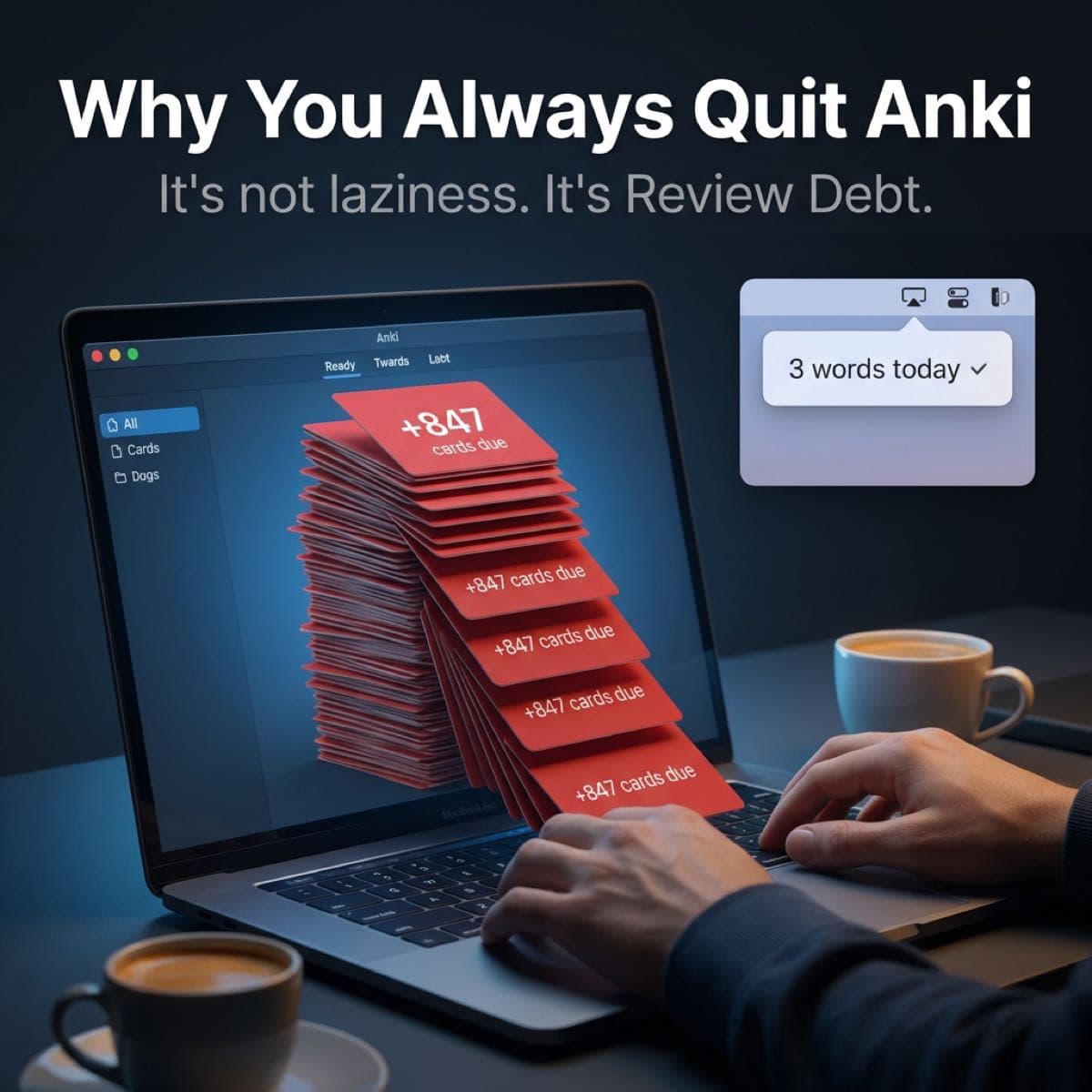
What Is Anki Review Debt?
Review Debt is the phenomenon where flashcard reviews accumulate faster than you can complete them in Spaced Repetition apps like Anki. When you miss a few days of study, the algorithm automatically stacks all overdue cards into your next session — creating an overwhelming backlog that triggers psychological burnout and, eventually, complete abandonment of the app.
The Insider Who Explained Why Anki Fails (It's Not What You Think)
Don't take it from us. Listen to a long-time Anki power user.
In 2019, a user writing under the pen name "iandanforth" published a detailed analysis on Medium explaining why he ultimately abandoned Anki — after years of committed use. What's striking is that he didn't blame himself for lacking discipline. Instead, he identified a specific design flaw in the app's architecture:
> "Anki will let you add as many cards as you want to a deck at a time without warning. ... Because there is no input rate limiting your backlog can grow at an unbounded rate."
>
> — iandanforth, "Why Anki Doesn't Work for Me", Medium, 2019
But he went further. He described the deeper psychological consequence — not just burnout, but a gnawing sense that nothing he was memorizing was actually real:
> "knowledge learned through Anki is fragile and shallow."
>
> — iandanforth, same article
This is the moment that resonates with thousands of Anki users: you press "Good" on hundreds of cards, but ask yourself about any of them a week later — and you draw a blank. Because you weren't learning. You were processing cards to clear your queue.
And this happens to nearly everyone — regardless of skill level or dedication. This is a systems problem, not a willpower problem.
Why Your Brain Is Wired to Run Away From Review Debt
To understand why Review Debt is so damaging, you need to understand a basic principle of behavioral psychology.
The human brain is hardwired to avoid feelings of overwhelm and defeat. When you open Anki and see "+500 cards due," your brain doesn't process this as a "learning opportunity." It processes it as a threat — the same way you'd react to opening a massive bill you have no idea how to pay.
Your body's response? Cortisol spikes. Amygdala activates. You want to escape.
The easiest escape? Close the app. Find something more manageable — scroll Twitter, watch YouTube, go to bed early.
This is not laziness. This is a completely normal neurological response from a brain trying to protect you from overwhelm.
The problem is: Anki doesn't care.
The SM-2 algorithm (Anki's foundation) was invented by Piotr Woźniak in 1987 — an era when people studied with paper flashcards, and "missing a day" didn't produce an instant avalanche of overdue cards. The algorithm is still brilliant from a cognitive science perspective. But it lacks a psychological protection layer for real-world users living in 2024.
The 3 Most Common Anki Mistakes (That Almost Everyone Makes)
Mistake #1: Importing a massive deck and enabling everything
This is the classic beginner blunder. You find a "4,000 IELTS words" or "Complete TOEIC Vocabulary" deck on AnkiWeb, download it, import it, and start learning with default settings (20–50 new cards per day).
What happens: Within one week, your daily review load can hit 100–150 cards. Miss three days? That number jumps to 300–400 overdue cards.
The Anki subreddit has a thread with over 2,000 upvotes titled "I have 1,847 cards due and I want to quit." In the comments, hundreds of users share nearly identical stories.
Mistake #2: Not setting a daily limit from day one
Anki lets you customize daily new card limits, but the default is 20 new cards per day — far too high for most beginners who are also holding down a full-time job.
Twenty new cards per day sounds manageable. But each new card will come back for review 7–10 times in the first few weeks. After two weeks, you're potentially facing 150–200 review cards per day — even if you stop adding new cards entirely.
Mistake #3: Suspending decks instead of pausing gently
When overwhelmed, many users "suspend" their entire deck — temporarily freezing all reviews. The problem: when they return, every overdue card queues up simultaneously. Instead of relief, they're hit with a flood of cards even larger than when they left.
Why "Catching Up" Never Actually Works
Many people tell themselves: "I'll just do a big catch-up session on the weekend." Logically, this makes sense. Psychologically and cognitively, it almost never works.
Here's why:
First: Working memory has a hard ceiling. Your brain can effectively process about 3–4 new pieces of information at once in short-term memory. When you sit down to review 400 cards in one session, retention quality drops sharply after the first 50–60 — you're skimming, not learning.
Second: Cognitive load increases under pressure. When you know you have a huge backlog to clear, your brain allocates mental resources to worrying about the remaining cards — rather than focusing on the card in front of you. Anxiety and learning don't coexist well.
Third: Active recall is replaced by pattern recognition. After 50–60 consecutive cards in a fatigued state, your brain starts recognizing patterns instead of genuinely retrieving memories. You press "Good" not because you remembered the word, but because you saw it three cards ago.
The result: You spend two hours "catching up" but retain only what you would have learned in 20–30 minutes of normal study.
How Wordrop Eliminates Review Debt by Design
At Wordrop, we built around a simple principle: A good learning tool should serve the user — not force the user to serve the algorithm.
Instead of trying to "fix" user behavior to fit how Spaced Repetition works, we redesigned the system itself to fit how busy professionals actually live. Two core principles drive everything:
Principle 1: Hard Cap — You Can Never Get Overwhelmed
Wordrop enforces a daily hard limit by default:
- Maximum 10 new words per day
- Maximum 20 review words per day
These numbers are calibrated for sustainable long-term habit formation. 30 words per day is enough to make consistent progress without needing to block out dedicated study time. You can handle 30 words in 5–8 minutes — perfectly sized for the natural micro-gaps in your workday.
Crucially: even if you want to do more in a given day, the system won't let you. This sounds counterintuitive, but it's an intentional design decision. Front-loading study creates a larger review burden in the days ahead — a "debt to your future self." Wordrop protects you from that.
Principle 2: Expire — Every Day Is a Fresh Start
This is the most important difference between Wordrop and Anki.
If today you have 30 words due, but you're too busy or too tired to study — that's fine. At midnight, today's quota expires. Tomorrow you start fresh with a new quota. No cards roll over. No debt accumulates.
You'll progress slightly slower in absolute terms — but your motivation stays protected. Every time you open Wordrop, you see a clean slate, not a ledger of failures.
Compare the psychological experience:
- Anki: Miss 3 days → Open app → See +300 red cards → Brain triggers avoidance response → Stop opening the app.
- Wordrop: Miss 3 days → Open app → See 30 words as normal → Brain processes normally → Keep learning.
What a Day of Learning With Wordrop Actually Looks Like
No extra apps to open. No "study time" to schedule. Wordrop runs quietly in your macOS menu bar and surfaces quiz popups during the natural dead moments of your workday.
| Time of Day | What Happens |
|---|---|
| 8:30 AM — Just sat down, coffee brewing | Popup appears. You answer 3 words while waiting. |
| 10:15 AM — CI/CD pipeline running | Popup appears. You review 5 words while waiting for deploy. |
| 12:00 PM — Lunch done, waiting for a meeting | Popup appears. You answer 4–5 more words. |
| 3:30 PM — Between tasks | Final popup. You clear today's remaining quota. |
| 6:00 PM | Today's quota is done. App won't interrupt you again. |
Total time spent: roughly 5–8 minutes, naturally distributed across the day. No sitting down to study. No remembering to open the app. Wordrop finds you.
Anki vs Wordrop: Side-by-Side Comparison
| Criteria | Anki | Wordrop |
|---|---|---|
| Backlog mechanism | Accumulates indefinitely. Easy to build massive debt. | Auto-expires at midnight. Zero accumulation. |
| Daily word limit | No default limit. Beginners frequently overload. | Hard Cap: 10 new + 20 reviews per day. |
| How it reaches the user | Destination app — you must remember to open it. | Ambient app — surfaces automatically during work gaps. |
| Platform | Windows, macOS, Android, iOS | macOS (optimized for Mac users) |
| Best suited for | Medical students, heavy custom-deck users. | Busy professionals, developers, remote workers. |
| Psychology after missing a day | Anxiety, guilt, avoidance. | Nothing changes. Fresh quota ready. Keep going. |
| Setup complexity | High — requires understanding decks, note types, ease factors. | Low — install and start learning immediately. |
Conclusion: You're Not Lazy — You're Using the Wrong Tool
If you've ever quit Anki, Duolingo, or any language app — stop blaming yourself. Those apps were designed for a user with an empty schedule, 30 free minutes every evening, and a job that never causes late-night incidents.
You — the person reading this — likely have a genuinely demanding job, an unpredictable schedule, and no consistent 30-minute window that reliably stays free across 365 days.
No tool is universally good or bad. There are only tools that fit your life, and tools that don't.
Language learning is a marathon, not a sprint. Five minutes a day for 365 days is worth far more than two intense weeks followed by burnout and abandonment. The best system is the one you actually maintain — not the one that's theoretically optimal.
👉 Try Wordrop free — Build your vocabulary during work, no extra app-opening habit required.
Frequently Asked Questions
Can you fix Review Debt inside Anki without switching apps?
Yes, but it requires manual configuration most beginners don't know about: lowering the daily new cards limit to 5–10, enabling "bury related cards," and using the "custom study" feature to cap daily reviews. These settings aren't default, and Anki's UI doesn't guide you toward them. Wordrop builds these guardrails in by default.
If Wordrop expires cards each day, do I lose progress?
No. Expiring a day's quota doesn't affect the long-term scheduling of any individual word in the Spaced Repetition system. The algorithm still knows when each word should next appear based on your recall history. Expiring simply means you didn't study that word today — not that you've forgotten it or need to restart from scratch.
What proficiency level is Wordrop designed for?
Wordrop is optimized for learners at approximately A2–B2 level who want practical English vocabulary for professional contexts — technical documentation, professional email, international team communication. If you're preparing for a board-level exam requiring 10,000+ custom cards, Anki gives you more flexibility. For career-focused vocabulary acquisition, Wordrop is the better fit.
Can Wordrop fully replace Anki?
For most working professionals learning English: yes. Wordrop ships with a pre-built high-frequency corpus — you don't need to find, download, and import decks like you do in Anki. If you're studying medicine or law and need thousands of domain-specific custom cards, Anki remains the more powerful option.
How do I stay consistent with language learning without burning out?
The answer isn't stronger willpower — it's designing a system where learning is the path of least resistance. Specifically: (1) eliminate the "remember to open the app" step by using software that delivers learning to you, (2) keep sessions under 3 minutes each, (3) never let tasks accumulate across days. These three factors remove every reason your brain has to avoid the habit.
Why do I keep forgetting words even after studying them?
Two most common causes. First, you're reviewing passively — scanning the card, recognizing it as familiar, pressing "Good" — rather than genuinely trying to retrieve the word before flipping. Second, when Review Debt forces you to review hundreds of cards in a single fatigued session, your brain shifts into pattern recognition mode rather than active recall. You "remember" the word because you saw it 10 seconds ago, not because it entered long-term memory.
What vocabulary should I learn first?
For professional English learners: prioritize technical vocabulary in your domain (architecture, APIs, reliability, agile/scrum terminology) combined with professional communication phrases (code review comments, async Slack messages, concise email). Avoid starting with conversational vocabulary — the ROI for career-oriented learners is significantly lower at the beginning.