
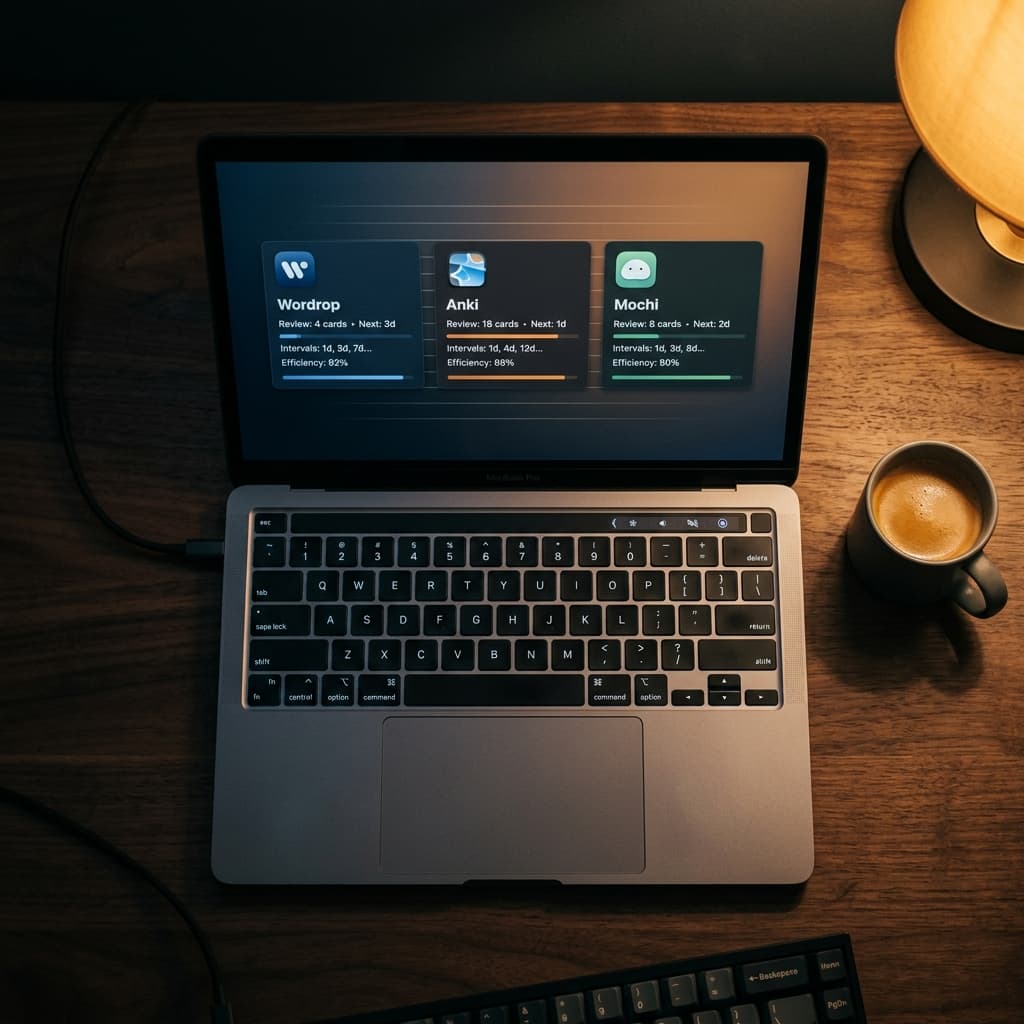
What Is the Best Spaced Repetition App for Mac?
The best spaced repetition app for Mac in 2026 is Wordrop for vocabulary learners who want passive, ambient learning during their workday. Anki remains the best choice for power users who need to memorize complex, mixed content. Mochi is the strongest option for students who want a modern interface with full SRS precision.
Spaced repetition (SRS) is the most evidence-backed method for long-term memory retention. Research on the Ebbinghaus forgetting curve shows that without timely review, you forget 70% of new vocabulary within 24 hours. SRS systems solve this by scheduling reviews at exactly the right intervals — right before your brain would forget.
The problem is that most SRS apps require you to open them. For professionals on Mac who spend 8–12 hours a day at their machine, the bigger barrier isn't the algorithm — it's remembering to show up.
What Makes a Spaced Repetition App Good for Mac Users?
Before ranking the apps, it's worth being specific about what "good" means for the Mac context:
| Criteria | Why it matters for Mac users |
|---|---|
| Native macOS app | Electron apps feel slow and out of place. Native = faster, better keyboard support, proper dark mode |
| No dedicated study session required | Professionals lose the habit when opening another app feels like homework |
| SM-2 or equivalent algorithm | SM-2 is the proven algorithm (40+ years of research). Weaker algorithms mean worse retention |
| Menu bar integration | The most frictionless trigger point for desktop users |
| Offline-first | No account, no sync dependency, no latency |
| Modern interface | Dated UI adds cognitive friction. You'll quit faster |
The 6 Best Spaced Repetition Apps for Mac in 2026
1. Wordrop — Best for Passive Vocabulary Learning on Mac
What it is: A macOS-native menu bar app that uses SM-2 spaced repetition to deliver vocabulary quizzes automatically throughout your workday. Wordrop runs in your menu bar, detects micro-idle moments, and shows a non-intrusive floating quiz overlay — without requiring you to open a dedicated learning app.
Why it stands out:
How the SRS works: Wordrop uses a simplified SM-2 implementation. Each word gets an interval that grows with correct recall — first review after 1 day, then 3 days, 7 days, 21 days, and so on. Words you struggle with get scheduled more frequently. Words you've mastered stop appearing until a maintenance review is due.
Best for: Software developers, product managers, designers, and knowledge workers on Mac who want to build professional English vocabulary without adding a study session to their day.
Limitations: Wordrop is vocabulary-specific. If you need to memorize anatomy diagrams, code syntax, or history facts, Anki's general-purpose deck system handles that; Wordrop does not.
Pricing: Free download (5 words/day, flashcard mode). Full unlock: from $2.99/month · $14.99/year · $19.99 lifetime — no subscription lock-in. Available on the Mac App Store →
2. Anki — Best for Power Users Who Need Full SRS Control
What it is: The gold standard of spaced repetition software. Anki runs on Mac via a Qt-based desktop app, supports thousands of community add-ons, and can memorize anything you can put on a card — vocabulary, anatomy, law, chemistry, music theory.
Why it's the most powerful SRS option:
The real limitation for most Mac users: Anki requires active engagement. You have to open the app, navigate to a deck, and commit to a study session. According to SM-2's creator, the system only works if reviews are done on schedule — and that requires a habit loop that many professionals never form. Anki's 2006-era interface doesn't help.
Best for: Medical students, law students, polyglots, and anyone who needs to memorize heterogeneous content at scale and is willing to invest setup time.
Pricing: Free on Mac desktop. AnkiMobile (iOS) is $24.99 one-time.
3. Mochi — Best Modern SRS App for Mac
What it is: A Markdown-based flashcard and spaced repetition app for macOS and iOS. Mochi uses true interval-based spaced repetition (similar to SM-2), supports rich card content including images, LaTeX, and code blocks, and has a significantly cleaner interface than Anki.
Why it's better than Anki for many users:
Limitation: Like Anki, Mochi requires you to open the app and initiate a review session. There is no passive or ambient learning mode. For consistent long-term use, you need an external reminder system (e.g., calendar block or notification).
Best for: Students who want beautiful, precise spaced repetition for mixed content and are willing to maintain a daily review habit.
Pricing: Free tier (limited card count). Pro plan starts at $5/month.
4. Wokabulary — Best Native macOS Vocabulary App with SRS
What it is: A vocabulary-focused app built natively for macOS (and iOS) with built-in spaced repetition scheduling. Wokabulary is purpose-built for language learners — you pick a language pair and start adding words immediately, with no deck configuration required.
Why it works for Mac users:
Limitation: Wokabulary requires you to open the app for review sessions. No menu bar mode. No passive ambient delivery. The SRS implementation is solid but less configurable than Anki or Mochi.
Best for: Language learners who want a polished Mac-native vocabulary app without the setup complexity of Anki, and who already have a reliable study routine.
Pricing: One-time purchase (~$14.99) on the Mac App Store.
5. Quizlet — Best for Access to Pre-Built Study Sets
What it is: The world's largest flashcard platform, available on Mac via browser and iOS app. Quizlet has millions of user-generated study sets covering vocabulary for nearly every language, exam, and professional context.
The SRS caveat: Quizlet's "Learn" mode uses an adaptive algorithm that resembles spaced repetition, but it is not true SM-2. The scheduling is less precise — intervals do not adapt to your individual recall performance in the same way. For exam cramming, Quizlet is excellent. For long-term retention, it underperforms genuine SRS apps.
Best for: Learners who want to study from pre-built word lists rather than building their own, especially for standardized tests (TOEFL, IELTS, JLPT).
Pricing: Free tier available. Quizlet Plus from $7.99/month.
6. Brainscape — Best for Confidence-Based Review
What it is: A web-based flashcard platform using Confidence-Based Repetition (CBR). Instead of Anki's Again/Hard/Good/Easy scale, Brainscape asks you to rate your confidence on a 1–5 scale, then prioritizes cards you feel least sure about.
Who benefits: Learners who find Anki's rating system unintuitive. The CBR approach is cognitively simpler and tends to have less friction for non-technical users.
Limitation: No native Mac app — browser only. Less algorithmically precise than SM-2 for maximum retention efficiency.
Pricing: Free tier. Premium from $9.99/month.
Side-by-Side Comparison
| Feature | Wordrop | Anki | Mochi | Wokabulary | Quizlet | Brainscape |
|---|---|---|---|---|---|---|
| SM-2 spaced repetition | ✅ | ✅ | ✅ | ✅ (similar) | Partial | Partial |
| Native macOS app | ✅ | ✅ (Qt) | ✅ | ✅ | ❌ browser | ❌ browser |
| Menu bar integration | ✅ | ❌ | ❌ | ❌ | ❌ | ❌ |
| Passive / ambient learning | ✅ | ❌ | ❌ | ❌ | ❌ | ❌ |
| Built-in vocabulary corpus | ✅ | ❌ | ❌ | ✅ | ✅ (user-made) | ✅ (user-made) |
| Memorize any content type | ❌ | ✅ | ✅ | ❌ | ✅ | ✅ |
| 100% offline | ✅ | ✅ | Partial | ✅ | ❌ | ❌ |
| Free to start | ✅ | ✅ | ✅ (limited) | ❌ | ✅ (limited) | ✅ (limited) |
| Modern macOS design | ✅ | ❌ | ✅ | ✅ | N/A | N/A |
Which Spaced Repetition App Is Right for You?
| Your situation | Best pick |
|---|---|
| You want vocabulary to come to you while you work on Mac | Wordrop |
| You need to memorize complex, mixed content at scale | Anki |
| You want beautiful flashcards with modern SRS | Mochi |
| You want a polished native Mac vocabulary app | Wokabulary |
| You want access to millions of pre-made study sets | Quizlet |
| You find Anki's rating system confusing | Brainscape |
The Science Behind Spaced Repetition
Spaced repetition is grounded in two well-established cognitive research findings:
The Ebbinghaus Forgetting Curve (1885): Memory retention decays exponentially after initial learning. Without review, you forget approximately 70% of new information within 24 hours and 90% within a week. Spaced repetition schedules reviews to interrupt this decay at the optimal moment — just before the memory fades.
The Testing Effect (Roediger & Karpicke, 2006): Active recall — retrieving information from memory — produces significantly stronger retention than passive review (re-reading, re-watching). Flashcard-style SRS apps exploit this by requiring you to retrieve the answer, not just recognize it.
The SM-2 algorithm, developed by Piotr Wozniak in 1987, formalized these principles into a scheduling system that is still used in Anki, Wordrop, and Mochi today. Studies on SM-2 have shown retention rates of 90–95% after 20+ years of use in structured review programs.
How Often Should You Do Spaced Repetition Reviews?
The short answer: as often as the algorithm tells you. The longer answer: SRS only works if you do your reviews on schedule.
| Review frequency | Retention outcome |
|---|---|
| Daily (on schedule) | 90–95% long-term retention |
| Skipping 1–2 days occasionally | Manageable — slight increase in review load |
| Skipping a week | Significant backlog; words start resetting |
| Quitting and restarting | Near-zero retention benefit from previous sessions |
This is why the delivery mechanism matters as much as the algorithm. Wordrop solves the consistency problem by removing the "open the app" step entirely. Anki, Mochi, and Wokabulary require you to have an existing habit or external trigger.
Frequently Asked Questions
What is spaced repetition?
Spaced repetition is a learning technique that schedules review sessions at increasing time intervals based on how well you remember each item. The better you know a word, the less frequently it appears for review. The algorithm ensures you spend the most time on what you're closest to forgetting — not on what you already know.
Is Anki still the best spaced repetition app in 2026?
Anki remains the most powerful and flexible SRS app for users who need to memorize diverse content types. However, for Mac users focused specifically on vocabulary learning, apps like Wordrop and Wokabulary offer a better experience because they remove setup friction and deliver content in a Mac-native format.
Does spaced repetition work for vocabulary?
Yes — it is the most evidence-backed method for vocabulary retention specifically. Research on second-language acquisition consistently shows that SRS-based vocabulary learning outperforms mass repetition (cramming), passive exposure, and unstructured study.
What's the difference between Wordrop and Anki?
Anki is a general-purpose SRS system where you create or import your own decks. Wordrop is a vocabulary-specific Mac app with built-in frequency-ranked corpora that quizzes you automatically throughout your workday via a floating overlay — without requiring you to open a dedicated study session. Anki requires deliberate scheduling; Wordrop integrates learning into your existing Mac workflow.
Can I use spaced repetition without an app?
Technically yes — the original Leitner box system used physical index cards sorted by review frequency. In practice, a software SRS app is more efficient because it handles scheduling precisely, tracks your performance, and does not require physical card management. For vocabulary specifically, the apps in this list cover all use cases from beginner to advanced.
Is spaced repetition better than Duolingo?
Duolingo uses spaced repetition as part of its underlying algorithm, but its gamification design — streaks, hearts, XP — optimizes for engagement over retention. A purpose-built SRS app with typed recall will produce better long-term retention for professional vocabulary because it prioritizes the testing effect over the entertainment layer.
The Bottom Line
If you're a developer, product manager, or knowledge worker on Mac who wants to build professional vocabulary without adding a study session to your day, Wordrop is the spaced repetition app built for exactly that situation. It uses SM-2, delivers quizzes automatically, and requires nothing more than 30 seconds when the overlay appears.
If you need to memorize complex content across multiple subjects, Anki is still the most powerful tool.
If you want modern SRS with beautiful cards, start with Mochi's free tier.