
What Is Passive vs. Active Vocabulary?
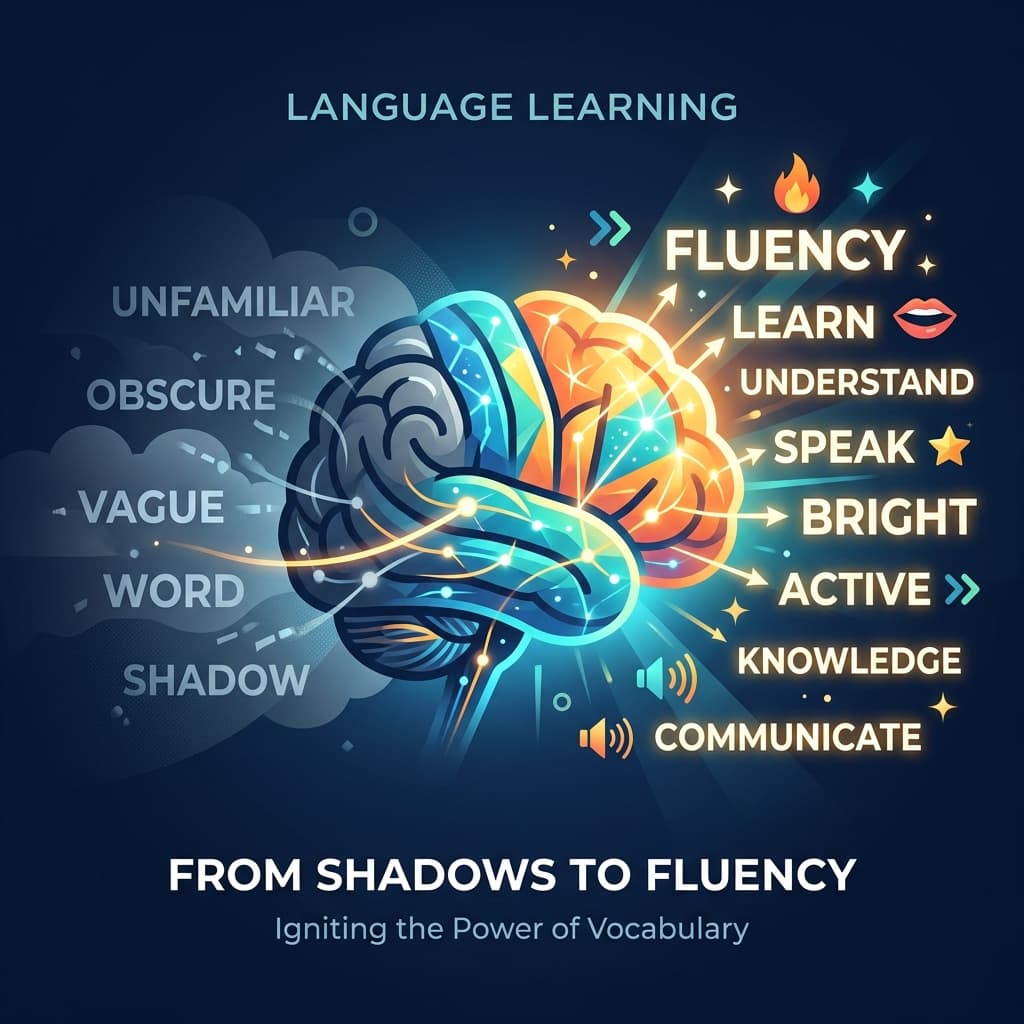
Passive vocabulary refers to words you can understand when reading or listening, but cannot spontaneously produce. Active vocabulary consists of words you can easily recall and use naturally in speech and writing. For most language learners, their passive vocabulary is up to five times larger than their active one—creating what linguists call a "ghost vocabulary."
Why Reading More Won't Make You Speak Better
It sounds counterintuitive, but if you want to speak better, simply reading more books or watching more movies is a trap.
When you read, your brain relies entirely on recognition. Recognition is cognitively cheap. You see a word, the context hints at its meaning, and you feel a false sense of fluency. But when you speak, your brain must use recall. Recall requires building entirely different neural pathways to retrieve information from scratch.
According to research in cognitive linguistics, the human brain categorizes words needed for comprehension differently than words needed for expression. A 2020 study on vocabulary acquisition showed that learners who engaged only in passive reading retained 60% less active vocabulary compared to those who practiced forced output.
To move a word from passive storage to your active toolkit, you must introduce friction. You have to force production.
Active vs. Passive Vocabulary: The Core Differences
Understanding how your brain treats these two types of memory helps explain why you "go blank" during conversations.
| Feature | Passive Vocabulary | Active Vocabulary |
|---|---|---|
| Cognitive Process | Recognition (reading/listening) | Recall (speaking/writing) |
| Brain Effort | Low friction | High friction |
| Context Reliance | Relies on surrounding words | Generated from scratch |
| Speed of Decay | Retained for years | Forgotten quickly without use |
| Size | Massive (thousands of words) | Limited (hundreds of words) |
The 3-Step System to Activate Your Vocabulary
Converting recognition into fluent use requires purposeful exposure, deliberate practice, and repeated retrieval. Here is a proven, actionable framework you can start today.
Step 1: Targeted Constraint (Limit Your Scope)
Don't try to activate 1,000 words at once. Select a target list of 10 to 20 high-utility words—words you recognize but never use. Prioritize vocabulary relevant to your daily professional life.* Action: Keep a physical diary or use a focused tool like Wordrop. Write down the word, its pronunciation, a clear definition, and crucially, 2-3 natural collocations (words that commonly go together, like "mitigate risk" or "render moot").
Step 2: Forced Production Drills
Reading your list isn't enough. You must use the words in meaningful contexts to build neural retrieval pathways.* Sentence Expansion: Write one simple, original sentence using the target word. Then, expand it by adding clauses and modifiers.
* The 1-Minute Monologue: Set a timer and record yourself speaking on a familiar topic, forcing yourself to use at least 5 target words. Do not read from a script.
* Feynman Technique: Explain the word out loud as if teaching it to a beginner, without using complex jargon.
Step 3: Spaced Repetition with Production
Standard flashcards often test recognition (e.g., matching a word to a translation). To build active vocabulary, you must test production.Instead of a flashcard that asks "What does 'amenable' mean?", create a card that prompts: "Use 'amenable' in a sentence about a project timeline." Schedule these reviews using spaced repetition intervals—after 1 day, 3 days, 1 week, and 1 month.
A Daily Routine for Active Vocabulary (20 Minutes)
Building active vocabulary doesn't require hours of study. A consistent 20-minute daily routine is far more effective:
- Review (5 mins): Use spaced repetition to recall your current target words (5-10 words).
- Active Recall (5 mins): Cover definitions and write one original sentence per target word.
- Production Drill (10 mins): Record a short voice note summarizing your day, deliberately inserting as many target words as possible.
Tip: Do not go into "beast mode" and try to learn 50 words a day. Emphasize quality over quantity. Five well-integrated words per day will transform your fluency faster than 50 shallowly reviewed ones.
How Wordrop Helps You Build Active Vocabulary
If managing flashcards and tracking repetitions sounds exhausting, you're not alone. We built Wordrop to solve this exact problem for busy professionals.
Instead of overwhelming you with endless lists, Wordrop operates on two core principles to guarantee active recall:
- Hard Cap: You learn a maximum of 10 new words and 20 review words per day. This prevents cognitive overload and ensures you have the mental energy to practice production, not just recognition.
- Ambient Learning: Wordrop runs quietly in your macOS menu bar, surfacing micro-quizzes during natural breaks in your workflow.
By integrating active recall into the dead moments of your workday, Wordrop helps you consistently turn passive knowledge into active, confident communication—without requiring dedicated "study time."
👉 Try Wordrop free — Build your active vocabulary seamlessly during work.