
# The Real English Barrier in Remote Jobs: It's Not What You Think
Does this scenario sound familiar?
You browse LinkedIn or Wellfound (formerly AngelList) and spot an international remote role that looks tailor-made for you. You scan the Job Description: system architecture, tech stack, tooling, agile ceremonies — 80% of it matches what you've been doing daily at your current job for the last four years.
You apply. Your resume passes. You crush the technical assessment or take-home challenge with flying colors.
Yet, after a 20-minute video conversation in the next round, you receive that all-too-familiar polite rejection email:
> "We were genuinely impressed by your strong technical background, but we have decided to move forward with candidates whose communication style more closely aligns with our remote team needs."
Your immediate reflex? "My English isn't good enough. I need to grind general English courses, practice conversational small talk with native tutors, or study grammar rules again."
Here is the contrarian truth: You don't lack general English. You misunderstand how English actually functions as a filter inside a global remote hiring pipeline.
Reframing the Myth: English Is Not an Absolute Barrier
In online discussions about remote work, conversations usually swing between two extremes:
Extreme 1 (The Absolute Wall): "English is the ONLY barrier. If you don't speak like a native speaker with flawless fluency, you have zero chance."*
Extreme 2 (The Dismissal): "Code is universal. If your technical chops are solid, employers don't care how you speak."*
Both positions miss reality.
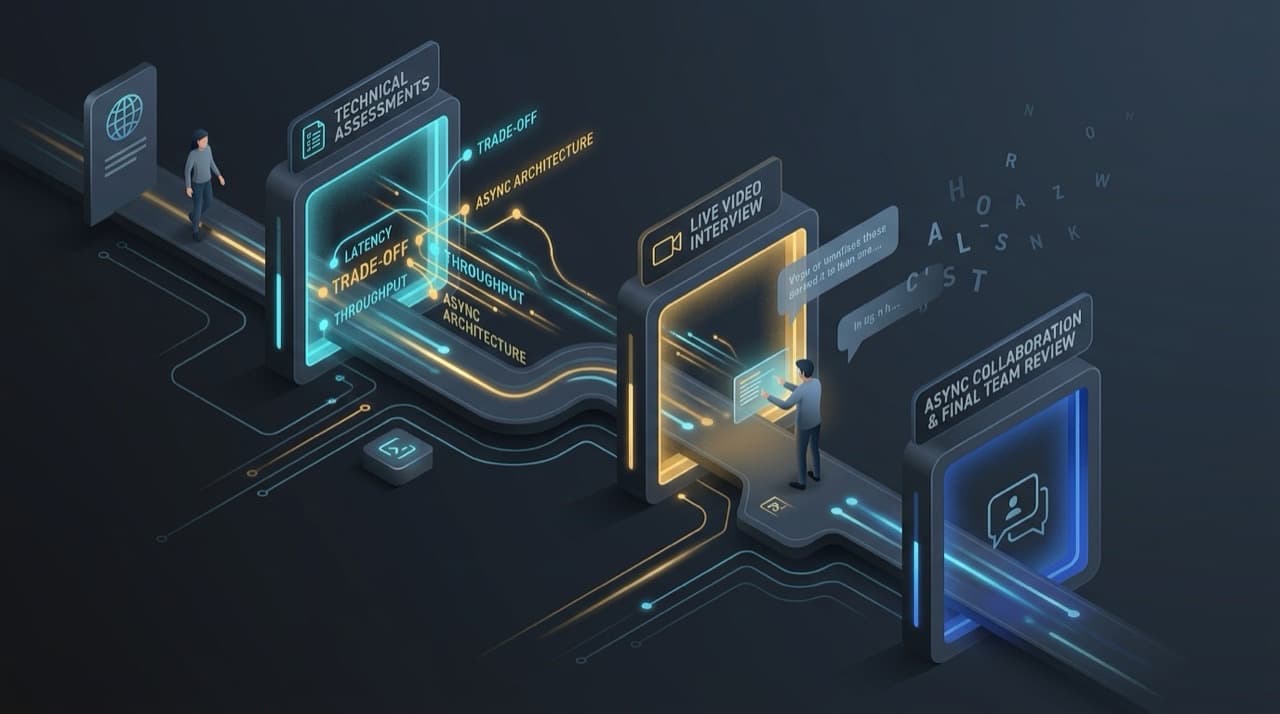
In international remote organizations, English does not operate as an all-or-nothing master key. Instead, it functions as a sequence of observable filters across distinct interview stages.
> English doesn't decide whether you are capable of doing the job — it decides which specific round eliminates you.
Once you view English through this lens, the mystery vanishes. Talented professionals aren't failing because their accent isn't American or British. They are stumbling into three very concrete, identifiable bottlenecks.
The 3 Concrete Bottlenecks That Filter Out Top Talent
Instead of treating "communication skills" as a vague, abstract bucket, let's break down where the leaks actually happen:
1. The Screening Stage: Lacking Standard Industry Terminology
In the initial recruiter screen or asynchronous Loom intro, talent acquisition specialists aren't testing your academic grammar. They are listening for one signal: Do you speak the standard dialect of our domain?
The instinctive, generic answer: When asked about system performance, a candidate says: "I made the system run much faster by changing the code and fixing some slow parts."* (Accurate, but sounds junior and imprecise).
The domain-specific answer: "I identified the database bottleneck and optimized query throughput, which reduced our p95 latency by 40%."*
Keywords like throughput, latency, bottleneck, redundancy, scalability, trade-off immediately communicate seniority.
When you lack precise domain vocabulary, recruiters struggle to map your seniority accurately. You get categorized as a mid-level executioner rather than the senior engineer or lead you actually are.
2. The Architecture & System Design Stage: Lacking the Vocabulary of Trade-Offs
This is where seasoned non-native professionals stumble most frequently.
When an interviewer asks: "Why did you choose PostgreSQL over MongoDB for that service?"
In your native language, your reasoning is crystal clear: data integrity, relational constraints, ACID guarantees, query patterns. But under interview pressure in English, your cognitive working memory is maxed out. You end up delivering a blunt answer: "Because Postgres is better for relational data and easier to maintain."
To a hiring manager, that response feels superficial. Top international teams don't look for "the best tool"; they evaluate how you balance trade-offs:
Consistency vs. Eventual consistency*
Operational overhead vs. Development velocity*
Migration risk vs. Long-term maintainability*
Without the vocabulary of rationale and consensus-building, your technical decisions appear intuitive rather than deliberate.
3. The Working Trial & Async Stage: Cognitive Load on Colleagues
Fully remote teams survive on asynchronous written communication — GitHub PRs, Slack/Discord threads, RFCs, and Notion architecture proposals.
If your Slack messages require three paragraphs of meandering context or use literal translations that require deciphering, teammates in different time zones must spend extra mental effort just to parse your intent.
In high-performing remote cultures, clarity and brevity are core competencies. If your messages introduce high cognitive load, the team instinctively senses friction: "Collaborating with this person across time zones will slow us down."
Comparison: General English vs. Domain-Specific Vocabulary
Notice how different the goals and results are when you shift focus:
| Dimension | General English (ESL / IELTS / Conversational) | Domain-Specific Vocabulary |
|---|---|---|
| Primary Goal | Daily life conversations, test scores, grammar rules | Passing professional and technical filters |
| Vocabulary Focus | Weather, hobbies, society, idioms, literature | Metric terms, trade-off phrasing, technical rationale |
| Impact on Remote Hiring | Helps with 5 minutes of pre-call small talk | Determines pass/fail in Technical & System Design rounds |
| Time Required | 1–2 years of broad conversational exposure | 2–3 months of targeted domain immersion |
| Observable Benchmark | "Can chat smoothly about weekend plans" | "Can justify an architectural decision concisely in 2 sentences" |
The Illusion: "I Read English Docs Easily, So My English Is Fine"
Many knowledge workers believe their English is battle-tested because they read API documentation, watch technical YouTube tutorials, and browse Reddit without subtitles.
Cognitive psychology reveals a critical distinction here: Passive Recognition is vastly different from Active Retrieval.
* When reading documentation, the words are right in front of you. Your brain only performs pattern recognition. It consumes minimal mental energy.
* In a live Zoom interview, you are presented with a blank canvas. Under time pressure and adrenaline, your brain must retrieve the exact domain term, structure the syntax, and speak — all within 500 milliseconds.
If your domain vocabulary lives only in your "passive memory" (you recognize it when you read it), it will fail you when you need to speak. You experience that agonizing sensation of the word being on the tip of your tongue, yet unreachable.
Reframing the Goal: What Actually Unlocks Global Remote Roles?
If your goal is to land international remote roles and work smoothly with global peers, the answer is not:
* Starting over with elementary grammar exercises.
* Memorizing 3,000 arbitrary academic words from test prep books.
* Trying to force a flawless American or British accent.
Instead, ask yourself this precise question:
> Do you have instant, active recall of the 200–300 core terms and phrases that define your specific professional domain?
Specifically, can you immediately pull up the words needed to:
Once you solve for this specific vocabulary layer, the "English barrier" stops being an intimidating wall and becomes an actionable, manageable checklist.
Self-Check: Are You Hitting the "Domain Vocab Filter"?
Take a quick audit of your daily workflow:
- [ ] You understand English technical docs effortlessly, but hesitate and stumble when explaining the same concept out loud.
- [ ] During interviews, you find yourself defaulting to vague words (good, bad, fast, make, do) to describe sophisticated technical solutions.
- [ ] Your written async messages or emails tend to be lengthy because you lack the concise industry idioms that summarize complex ideas in a few words.
- [ ] You pass coding tests or take-home challenges consistently, but repeatedly stall at the System Design or Hiring Manager round.
If you checked two or more of these boxes, your priority is clear: stop trying to learn "more English in general" and start mastering the active retrieval of your domain's specific vocabulary.
Frequently Asked Questions (FAQ)
Do global remote jobs require official certificates like IELTS or TOEFL?
No. High-growth tech companies and international remote startups virtually never ask for language certificates. They evaluate your communication directly through your resume, asynchronous written exchanges, Loom videos, and live interview discussions.How long does it take to build a solid domain vocabulary?
Because domain vocabulary is narrow and highly focused compared to the entire English language, targeted practice with active recall and spaced retrieval can yield noticeable interview confidence within 6 to 8 weeks.If my speaking fluency is still weak, where should I start?
Start with asynchronous writing. In remote environments, 70–80% of daily communication occurs via text (tickets, documentation, Slack). When you write with precision and clarity using standard domain terminology, your spoken confidence naturally follows.Summary
Don't let the belief that "my English isn't good enough" keep you from exploring global opportunities.
English in the workplace is not a literature exam. It is a communication protocol. And just like any protocol, the objective is simple: transmit the right information, use standard syntax, and minimize noise.
When you focus on mastering the exact vocabulary of your domain, the door to international remote work opens much faster than you think.