
# Active Recall vs Passive Learning: Which One Actually Works?
The Real Reason You Keep Forgetting Vocabulary
Here's a pattern most language learners recognise immediately:
You write down a page full of new vocabulary. You read through the list, muttering the meanings to yourself. You nod along: "Yeah, I know this one." Or you download a language app, tap through a few multiple-choice quizzes, get a streak, and feel highly productive.
Three days later — you need to write an important email or you're trying to speak with a native speaker. The word is right there on the tip of your tongue, but your mind goes completely blank. You can't produce it.
You don't have a "bad memory." The problem is your learning method.
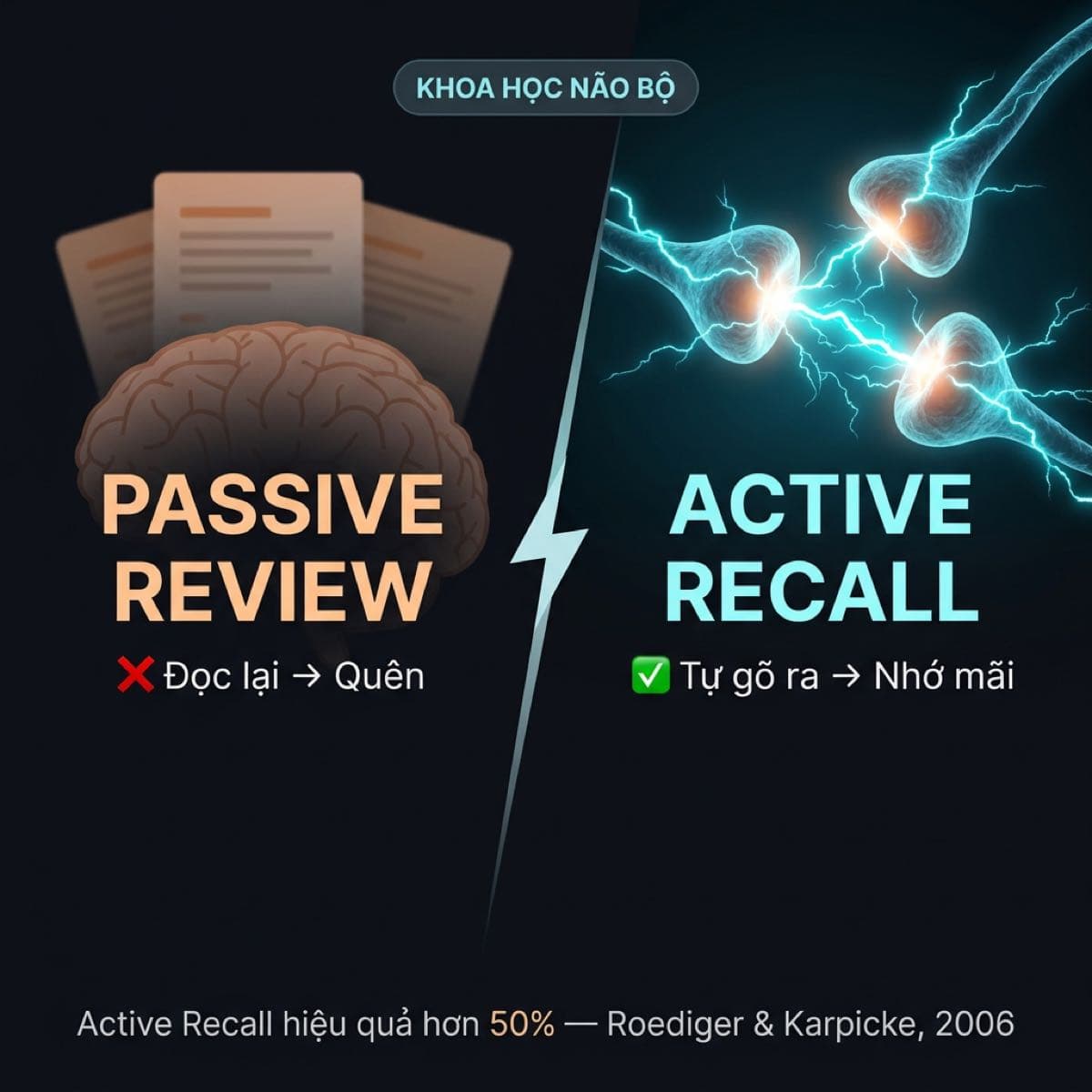
And here's the part that's hard to accept: Research from Washington University (Roediger & Karpicke, 2006, Psychological Science) found that passive study methods — re-reading, scanning lists, writing things out repeatedly — produce up to 50% less retention than active recall. Two groups studied the same material. Group one re-read it four times. Group two read it once, then tested themselves three times. After one week, group two retained nearly twice as much.
The method that feels harder is the method that works. The one that feels easy? It's mostly an illusion.
What Is Passive Learning? (And Why It Feels Like It's Working)
Passive learning is any form of studying where you receive information rather than producing it.
Common examples in language learning:
- Re-reading a vocabulary list over and over
- Watching YouTube or Netflix with subtitles in your native language
- Looking at a flashcard and flipping it immediately to see the answer
- Highlighting every new word in a textbook
- Tapping the correct answer from four choices on a language app
The problem isn't that these methods are completely useless. The problem is that your brain is deceived by the fluency illusion.
When you see the word "negotiate" for the third time in your reading, your brain recognizes it — and immediately signals: "I know this."
But recognizing a word on a page ≠ retrieving it when you need it in conversation.
In real-world communication, there are no subtitles, and nobody gives you a multiple-choice menu to pick from. You have to pull the word out of your brain unprompted — and that's an entirely different cognitive skill, one that passive learning never trains.
What Is Active Recall? (Why Your Brain Resists It but Needs It)
Active recall is the deliberate process of forcing your brain to retrieve information from memory — without any hints, answers, or study materials visible.
Practical examples:
- See the word in your native language → type or write the English equivalent from memory
- Read a definition → recall the word without looking
- See the English word → explain the meaning in your own words without checking a dictionary
- After reading a news article in English: close it and ask yourself, "What three new phrases did I just learn?"
Why does it work so much better?
Each time you retrieve information from memory — whether you get it right or not — your brain creates a stronger memory trace. This process is called memory consolidation.
Neurologically: active retrieval intensely fires the synaptic connections associated with that word, making that neural pathway more durable over time.
Passive review? It only fires those connections lightly. Not enough to build deep roots.
Side-by-Side Comparison: Active Recall vs Passive Learning
| Criteria | Passive Learning | Active Recall |
|---|---|---|
| How it feels while studying | Easy, comfortable, "productive" | Harder, exhausting, often blanking |
| Time per session | Longer (scanning many words) | Shorter (requires intense focus) |
| Retention after 1 week | Low (~30–40%) | High (~70–80%) |
| Accuracy in real conversation | "I understand it but I can't say it" | Reliable retrieval when speaking |
| Example methods | Re-reading, subtitles, multiple choice | Blind self-testing, typing the answer |
| Which brain mechanism? | Recognition | Retrieval |
_(Retention data: Karpicke & Roediger, 2008, Science; Cepeda et al., 2006, Psychological Bulletin)_
The Testing Effect: The Science That Explains Everything
One of the most robust findings in cognitive psychology, commonly called the Testing Effect:
> Being tested on information helps you remember it significantly longer than simply reviewing it again — even when you answer incorrectly during the test.
Roediger & Karpicke (2006) ran the definitive study. Four groups, same material:
- SSSS: Study it four times (study, study, study, study)
- SSST: Study three times, tested once (study, study, study, test)
- STTT: Study once, tested three times (study, test, test, test)
Results after one week:
- SSSS: ~40% retained
- SSST: ~56% retained
- STTT: ~61% retained
The twist: immediately after studying, group SSSS felt the most confident about what they'd learned. Group STTT felt uncertain and frustrated. After one week, results were entirely reversed.
The discomfort you feel during active recall is not a sign of failure. It is the signal that your brain is "lifting weights." If studying feels completely smooth, you're probably not actually learning.
Why Many Learners Get Stuck at "I Understand but Can't Speak"
This is the most common pattern for adult language learners:
Step 1: You encounter a new word while scrolling LinkedIn, reading the news, or watching a video.
Step 2: You check the dictionary. "Ah, that makes sense." You move on.
Step 3: A few days later, you see the same word. It looks familiar, you check the dictionary again. "Oh right, I remember now."
Step 4: You do this 20 times. You still can't actively use the word in your own sentences.
The reason: you are passively reviewing on a loop. Your brain never has to pull the information out itself because you provide the answer immediately.
How active recall fixes this:
Instead of checking the dictionary immediately — pause for 5 seconds and attempt to remember it first. Even if you fail completely. The moment your brain searches its database and struggles is precisely when it prepares the ground to plant the memory deeper once you finally see the answer.
Active Recall + Spaced Repetition = The Combination That Sticks
Active recall alone still isn't the full picture. You also need to practice it at the right moment — just before your brain is about to delete the word.
This is exactly why the SM-2 spaced repetition algorithm was built.
SM-2 tracks and calculates exactly when each word needs to be reviewed. Remember it well? You'll see it again in a week, or a month. Keep forgetting it? You'll be tested on it tomorrow.
The combination:
- Active Recall: You force yourself to remember the meaning and type the word out — no multiple-choice safety nets.
- Spaced Repetition: The review schedule is optimized automatically, with no over-studying or under-studying.
This is precisely how the SM-2 algorithm works — and why it's the scientific foundation behind Wordrop.
Why Most People Default to Passive Learning Anyway
Simple answer: because passive learning is comfortable.
Looking at a neatly translated vocabulary list feels smooth and stress-free. Active recall forces you to try, face the reality of forgetting, and stare at a blank screen.
But that discomfort is exactly why it works. What psychologists call desirable difficulty (Bjork, 1994) — learning methods that create effort and friction during the process tend to produce significantly stronger, longer-lasting results.
The methods that feel the easiest while learning are usually the least effective for long-term retention.
How to Apply Active Recall Starting Today (Without Extra Time)
You don't need to overhaul your life. Small tweaks produce dramatically different outcomes:
1. Change how you use flashcards
❌ Wrong: Look at the English word → glance at the translation immediately → move on.
✅ Right: Look at the English word → close your eyes, define it in your own words → only then check the answer.
2. Type it out instead of picking A, B, C, or D
❌ Wrong: A language app gives you four options, you tap the one that looks right.
✅ Right: An app gives you the definition, and you have to type out every letter of the word yourself.
When you type or write, you are training the exact retrieval path you'll need when composing an email or typing a message.
3. Practice in both directions
- Direction 1: Native Language → English (Harder, builds active speaking/writing skills)
- Direction 2: English → Native Language (Easier, builds reading/listening comprehension)
4. Endure the "Blank"
When you forget a word — don't reach for Google Translate immediately. Force yourself to endure that uncomfortable feeling for 5–10 seconds. Try to remember the context where you last saw it. That mental strain is highly valuable for your memory.
The Bottom Line: The Uncomfortable Truth
| If you are doing this... | Your brain is actually... |
|---|---|
| Re-reading your vocabulary notebook | Recognizing letters, not learning how to use the word |
| Tapping 'translate' instantly | Becoming lazy and refusing to store the memory |
| Tapping multiple-choice quizzes | Creating an illusion of fluency |
| Typing answers from memory on a schedule | Building genuine linguistic reflexes |
How Wordrop Implements Active Recall
Wordrop is designed not as a game, but as a real vocabulary builder grounded in science:
Pure Active Recall:
No multiple choice. No lifelines. You have to type out the answer. Your brain must do the hard work of retrieving the word.
Automated Spaced Repetition:
The underlying SM-2 algorithm manages your review schedule. Hard words appear more often; easy words are pushed further into the future. You never have to manage a list yourself.
The part that makes it sustainable:
Instead of demanding 30 minutes of your time inside an app, Wordrop drops a tiny notification (a quiz) on your Mac menu bar while you work. You spend 30 seconds typing the answer, then get back to work.
Your brain gets continuous, brief stimuli throughout the day, consolidating memories in the most natural and durable way possible.
Frequently Asked Questions
Does active recall work for beginners?
Yes. In fact, it might be more important for beginners because early learning is when you forget things the fastest. The key is to start small: just 5–10 words a day. Blanking frequently at the start is normal. Once your brain gets used to being "tested," your retention will skyrocket.
How long should I use Active Recall each day?
Science shows that five short 3-minute sessions are better than one long 15-minute session. The gaps between sessions allow your brain to "digest" and consolidate the memories. That's why Wordrop approaches you multiple times a day with micro-quizzes.
Does this mean I should stop watching movies or listening to English music?
Not at all! Passive exposure or "language bathing" helps you get used to intonation, pronunciation, and culture. But if your goal is to acquire new vocabulary you can actually use, active recall must be your primary weapon. Passive exposure is like applying moisturizer; active recall is like lifting weights.
Why do I feel a slight headache or tension when using Active Recall?
Because you are forcing your neurons to work instead of rest. That mild tension is a signal that your brain is expanding its capacity. It’s exactly like muscle soreness after a good gym workout.
What is the difference between Active Recall and SM-2?
Active recall is how you study (pulling information from memory instead of looking at the answer). SM-2 is when you study (the algorithm calculating your review schedule). Wordrop combines both to create the optimal learning environment. Read more about how the SM-2 algorithm works.
The Final Takeaway
If you've ever invested time in studying vocabulary only to feel disappointed when you forget everything — stop blaming yourself.
Your memory is fine. "Passive Learning" simply put it to sleep. When you switch to Active Recall, accept a bit of discomfort, and force your brain to do the work, you will see a difference almost immediately.
Science has proven this. The SM-2 algorithm was born from it. And Wordrop brings that entire process to your menu bar.
30 seconds at a time. Active retrieval. At the exact right moment.
That is the only way vocabulary stays with you forever.
References: Roediger & Karpicke (2006), Psychological Science 17(3); Karpicke & Roediger (2008), Science 319; Cepeda et al. (2006), Psychological Bulletin 132(3); Bjork, R.A. (1994), Memory, in A. Collins, S. Gathercole, M. Conway & P. Morris (Eds.), Theories of Memory.