
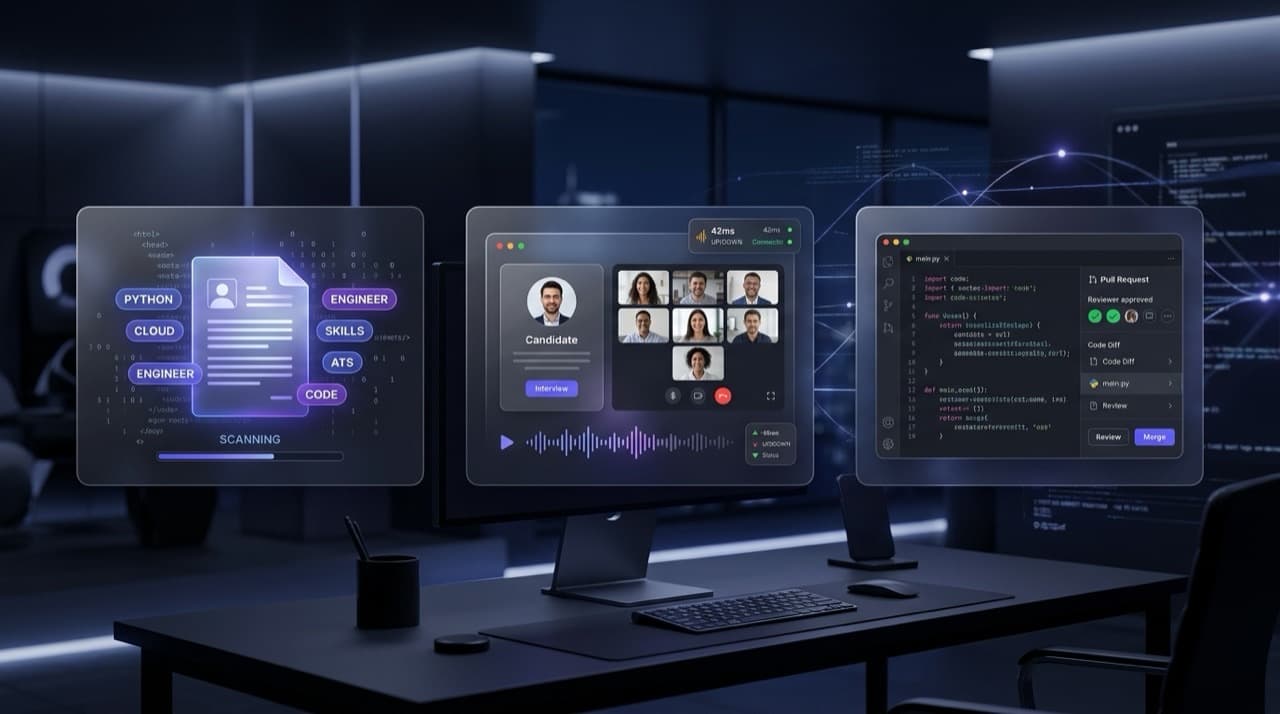
# 3 Remote Interview Rounds Where Weak English Gets You Eliminated
Does this scenario sound familiar?
You spend your entire evening polishing your profile on LinkedIn and Wellfound. You discover an international remote role offering $4,000 to $7,000 per month.
Reading through the Job Description, you feel a wave of confidence: from the system architecture and cloud infrastructure to agile delivery workflows and problem-solving scenarios, you have handled virtually all of it daily at your current company for the past four years. You know you can execute this work at a high level.
Yet, one of three painful outcomes occurs:
- You submit your resume and hear nothing: Complete silence, or an automated email within 48 hours: "Unfortunately, after careful review, we have decided to move forward with other candidates."
- You ace the code test, but freeze on the live call: You score top marks on the take-home technical challenge, but when speaking with the Hiring Manager over Zoom, your brain locks up. The sharp architectural insights you hold in your head turn into halting, fragmented sentences filled with "you know", "like", and "something like that".
- Your async assignment gets rejected for communication: You submit a design proposal or a simulated incident response, only to receive brief feedback: "Technical thinking is sound, but asynchronous communication lacks clarity and actionable structure."
The instinctive reaction for most developers, product managers, and designers is: "My English must be terrible. I need to sign up for an IELTS 7.5 prep course or hire an expensive native-speaking tutor to practice casual conversation."
Here is the truth that will change your perspective: You do not lack general English ability. You are simply getting caught in 3 distinct linguistic filters built into modern remote hiring funnels.
English in Remote Jobs: An Operational Filter, Not a Test of Eloquence
When global remote companies (especially Silicon Valley startups, European scale-ups, and async-first pioneers like GitLab, Zapier, and Automattic) hire distributed engineers and product builders, they are not looking for Shakespearean prose. They are screening for a team member who can collaborate synchronously and asynchronously across time zones without creating ambiguity, delays, or costly misunderstandings.
English in international hiring does not operate as a single generic barrier. It functions as 3 distinct operational checkpoints:
* Checkpoint 1: The algorithmic gatekeeper (ATS keyword scanner).
* Checkpoint 2: The high-pressure live retrieval test (Screening call & system design).
* Checkpoint 3: The asynchronous collaboration challenge (Written RFCs, PR reviews, Slack simulations).
If you do not arm yourself with the exact domain vocabulary each checkpoint demands, you will be rejected early — regardless of whether your raw technical abilities rank in the top percentile.
Let us break down what happens at each stage and the exact category of vocabulary you need to prepare.
Round 1: CV & ATS Keyword Scan — What the Algorithm Actually Looks For
Before any human recruiter reads your resume, it passes through an Applicant Tracking System (ATS) — platforms such as Greenhouse, Lever, Ashby, or Workday.
For an attractive global remote opening, companies routinely receive between 400 and 1,500 applications per role. No talent team manually reviews that volume. They configure automated keyword queries and relevance scoring algorithms.
The Fatal Candidate Mistake
Most non-native candidates draft bullet points using weak, passive phrasings:
> "Responsible for developing backend features and fixing bugs."
> "Helped team manage tasks and supported enterprise clients."
These sentences are grammatically accurate. But to an ATS scoring engine, their informational value is close to zero. Verbs like "responsible for", "helped", "did", and "supported" are passive fluff words — they transmit zero quantitative signal regarding technical scope, architectural ownership, or business impact.
The Vocabulary You Actually Need: Architecture & Measurable Impact Verbs
ATS scoring engines and experienced technical recruiters look for two specific categories:
- Measurable Impact Action Verbs: Precision verbs indicating high-level engineering ownership — verbs describing system refactoring, scale optimization, latency reduction, pipeline automation, resilience hardening, and operational risk mitigation.
- Standardized Architectural Domain Nouns: Exact industry terminology defining distributed architecture (e.g., fault tolerance, eventual consistency, schema migration strategies, throughput throttling, telemetry instrumentation).
When your CV lacks these precision verbs and technical nouns, automated parsers downgrade your resume to the bottom quartile before a recruiter ever lays eyes on it.
> Corresponding Domain Word Pack: Software Engineering Core & Tech Architecture Pack (Focuses entirely on quantifiable engineering impact verbs and globally standard architecture terms).
Round 2: Technical & Functional Screening — The 30-Second Retrieval Crunch
If your resume clears the ATS scan, you advance to a 30-to-45-minute live video conversation with the Hiring Manager, Staff Engineer, or VP of Engineering.
This is where many experienced candidates stumble: You understand 95% of what the interviewer says, but when it is your turn to speak, your active vocabulary fails you.
Why Strong Engineers Get Rejected Live
In a live video screening, the interviewer is not grading your accent or whether you sound like a native Londoner. They are monitoring two hidden metrics:
- Retrieval Speed: When asked how you mitigated a production bottleneck or architected an event-driven system, can you retrieve the precise technical vocabulary within 1.5 seconds? Or do you pause for 12 seconds, staring upward while translating words from your native language?
- Trade-off Articulation: Remote engineering hinges on autonomy. You must make technical choices and defend them cleanly to teammates distributed across continents. If your response is reduced to: "We used Redis because it is very fast", the interviewer concludes you lack senior engineering maturity.
The Vocabulary You Actually Need: Trade-off & Justification Terminology
You do not need to study general vocabulary lists. You need a dedicated mental cache of engineering justification phrases:
* Trade-off Framing Structures: Patterns for contrasting operational overhead against implementation velocity, flexibility against cognitive complexity, or immediate delivery against long-term maintainability.
* Root-Cause & Incident Analysis Vocab: Precise terminology for explaining error propagation, cascading bottlenecks, degradation thresholds, and structural remediation steps.
* Conversational Signposting Phrases: Professional bridging phrases that allow you to structure multi-part answers logically while maintaining authority under interview pressure.
With this active vocabulary at your fingertips, your explanations immediately reflect the composure of an experienced international practitioner.
> Corresponding Domain Word Pack: System Design & Live Technical Discussion Pack (Builds instant retrieval speed for live technical justifications and architecture trade-offs).
Round 3: The Async Writing Test — The Defining Test of Remote Culture
This is the round that catches many candidates off guard. You pass the live interview, and the hiring team assigns an asynchronous evaluation:
* Author an RFC (Request for Comments) or Technical Design Document proposing a solution for an upcoming product initiative.
* Draft a Slack communication resolving an urgent prioritization clash between product management and engineering.
* Review a simulated Pull Request (PR) and provide written architectural and code quality feedback.
The Traditional English Fallacy
Many candidates with strong academic English credentials (IELTS 7.5 or TOEFL 100+) fail this round decisively. Why?
Academic English trains you to construct lengthy, multi-clause paragraphs bound together by formal connectors like "Furthermore", "Notwithstanding the above", and "It can be argued that".
In a high-performing remote team, that style is an expensive communication anti-pattern. Remote colleagues across 6 time zones do not have time to parse literary prose. They require conciseness, directness, and unmistakable clarity.
The Vocabulary You Actually Need: Professional Async Collaboration Vocabulary
To succeed in asynchronous evaluation tasks, you must master:
* BLUF Structure (Bottom Line Up Front): Opening with the core decision, risk, or recommendation first, supported by high-intent action verbs rather than wandering preambles.
* Constructive PR Review Vocabulary: Terminology that separates critical blocking architectural concerns from optional subjective suggestions (e.g., distinguishing non-blocking polish from systemic vulnerabilities) without creating defensive friction.
* Scope & Alignment Lexicon: Precise phrasing for establishing acceptance criteria, SLA boundaries, dependencies, and rollout constraints.
> Corresponding Domain Word Pack: Async Collaboration, PR Review & Product Alignment Pack (Captures the exact writing conventions, Slack shorthand, and documentation standards used by leading Silicon Valley distributed teams).
Comparison: The 3 Remote Interview Gatekeepers
| Dimension | Round 1: CV / ATS Scan | Round 2: Live Screening Call | Round 3: Async Writing Test |
|---|---|---|---|
| Evaluator | ATS Algorithms + Tech Recruiter | Hiring Manager / Staff Engineer | Entire Cross-Functional Team |
| Test Nature | Keyword relevance & scope matching | Real-time reasoning & pressure retrieval | Written clarity without live interaction |
| Common Failure Cause | Generic passive verbs, absence of measurable technical outcomes | Vocabulary retrieval freezing, simplistic one-dimensional arguments | Overly academic or verbose writing, absence of BLUF structure |
| Core Vocabulary Required | Architecture & Measurable Impact Verbs | Trade-off & Incident Analysis Terms | Concise Async & PR Review Lexicon |
| Underlying Question | "Does this person have proven hands-on experience in this stack?" | "Will technical discussions with this engineer be productive or exhausting?" | "Can this person drive projects smoothly via Slack, PRs, and Docs?" |
Why Conventional English Study Fails at All 3 Checkpoints
If you recognize your weak points across these three stages, typical solutions will not help you:
* Studying general grammar books covering obscure tenses.
* Attending conversational classes discussing travel, cinema, or environmental policy.
* Passively listening to technology podcasts while doing chores, hoping vocabulary will stick.
These approaches fail due to two fundamental flaws:
1. Severe Context Mismatch
You need language to debate distributed locking mechanisms or write crisp PR feedback, yet you are feeding your brain words related to climate agreements or museum exhibits. When sitting before an interviewer, your brain possesses zero contextual neural pathways to retrieve the vocabulary you need.2. The Illusion of Passive Competence
Reading tech articles and understanding every word creates the feeling that you know the material. But that is passive recognition. In an interview, you must execute active retrieval within 500 milliseconds. Without deliberate retrieval practice from memory, your brain freezes when the spotlight turns to you.The Strategic Path Forward: Domain-Driven Active Recall
To conquer international remote interviews, you need a lean, deliberate strategy:
flowchart LR
    A["Select Domain Pack<br/>(Dev / PM / Tech Remote)"] --> B["Ingest Targeted Vocabulary<br/>(Impact / Trade-off / Async)"]
    B --> C["Active Recall Practice<br/>(Type from memory, no multiple choice)"]
    C --> D["Spaced Repetition Engine (SM-2)<br/>(Review right before forgetting)"]
D --> E["Effortless Natural Retrieval<br/>in Interviews & Daily Work"]- Target Deep Domain Vocabulary: Channel 100% of your cognitive energy into the precise domain word packs your daily work and interviews demand.
- Train Active Recall Retrieval Paths: Reject passive multiple-choice apps. You must see the real-world operational context and type the exact word yourself. Typing activates the identical motor and cognitive retrieval circuits you rely on when writing code, reviews, and documents.
- Automate Spaced Repetition (SM-2): Let a proven algorithm determine your forgetting curve, serving review items precisely when memory traces begin to fade.
How Wordrop Solves This Directly on Your Mac Menu Bar
Instead of requiring 90 minutes of exhausting evening study after a grueling workday, Wordrop integrates directly into your existing workflow:
* Curated Domain Word Packs: Tailored specifically for Software Engineers, Tech Leads, Product Managers, and Remote Professionals — containing only the operational vocabulary that determines hiring success across the 3 remote interview stages.
* Pure Active Recall: No gamified multiple choice. No artificial hints. Wordrop presents professional scenarios and requires you to retrieve and type the target term.
* Subtle macOS Menu Bar Integration: Throughout your workday, lightweight 30-second quizzes appear quietly in your menu bar. You type the answer, cement the neural pathway, and return immediately to your tasks without context switching.
* Automated SM-2 Optimization: Words you retrieve effortlessly are scheduled further out; terms you hesitate on are reintroduced with algorithmic precision, converting passive knowledge into instant professional reflexes.
Explore Wordrop Domain Word Packs →
Summary: Two Distinct Mindsets
| Candidates Who Struggle Often Believe... | Candidates Who Secure Remote Roles Realize... |
|---|---|
| "My English is fundamentally flawed; I must re-study all grammar and take language exams." | "I only lack the targeted domain vocabulary specific to each remote hiring filter." |
| Reading plenty of documentation is enough, yet freeze during live technical discussions. | Daily active recall practice is necessary to push retrieval latency below 1 second. |
| Resumes and design docs should feature complex, verbose, academic-style phrasing. | Async communication demands BLUF clarity and direct, measurable action verbs. |
| Trying to cram 2 hours every evening, burning out and quitting within two weeks. | Micro-sessions of 30 seconds distributed through the workday build sustainable, long-term mastery. |
Frequently Asked Questions (FAQ)
1. My current English level is around technical reading (CEFR B1/B2). Do I realistically have a chance at a global remote role?
Yes. If you can read technical documentation comfortably, your passive vocabulary base is already substantial. Your only bottleneck is activating that knowledge into an active retrieval state and adopting the standard trade-off phrases required during live interviews. You do not need 5,000 new words; you need 300 to 500 high-frequency domain terms fully activated.2. Do I need to eliminate my accent and sound like a native speaker to pass the screening interview?
No. Global remote teams are inherently multicultural. Your colleagues will be based across Eastern Europe, Latin America, Southeast Asia, and Germany — each speaking with distinct accents. International hiring managers evaluate clarity of thought, precision of technical vocabulary, and absence of ambiguity, never the geographic origin of your accent.3. Why does this article avoid providing an exhaustive list of specific words for each round?
Because reading a static list of printed words is the very definition of passive learning — it provides a fleeting feeling of understanding, but vanishes from memory within days. To actually command these terms in an interview, you must practice retrieving and typing them within realistic workplace prompts via deliberate active recall systems like Wordrop.4. Can I use AI tools (such as ChatGPT) to complete the asynchronous writing test?
Many remote companies allow AI for light proofreading. However, hiring teams immediately detect generic, boilerplate AI prose that lacks personal engineering nuance, real architectural trade-offs, and company-specific context. Furthermore, if you rely entirely on AI to write your design doc, you will be exposed immediately during the subsequent live defense round. Cultivating your own sharp async writing ability is the only durable career strategy.Conclusion
Landing a high-compensation global remote role is not reserved for native English speakers or individuals with elite exam scores.
It rewards professionals who understand the mechanics of the hiring system: candidates who know exactly what each interview stage evaluates and arrive equipped with the precise domain vocabulary demanded by each gatekeeper.
Do not let exceptional engineering talent go unrewarded simply because of a missing cluster of specialized technical vocabulary when opportunity arrives.
Target your domain. Practice active recall daily. Master every round.
References & Research Inspiration: Roediger & Karpicke (2006) on the Testing Effect and Retrieval Dynamics; GitLab 2024 Global Remote Work Report; Ashby 2025 State of Tech Hiring Report; The Pragmatic Engineer (Gergely Orosz) on international technical interviewing standards.