
The Paradox of Memorization
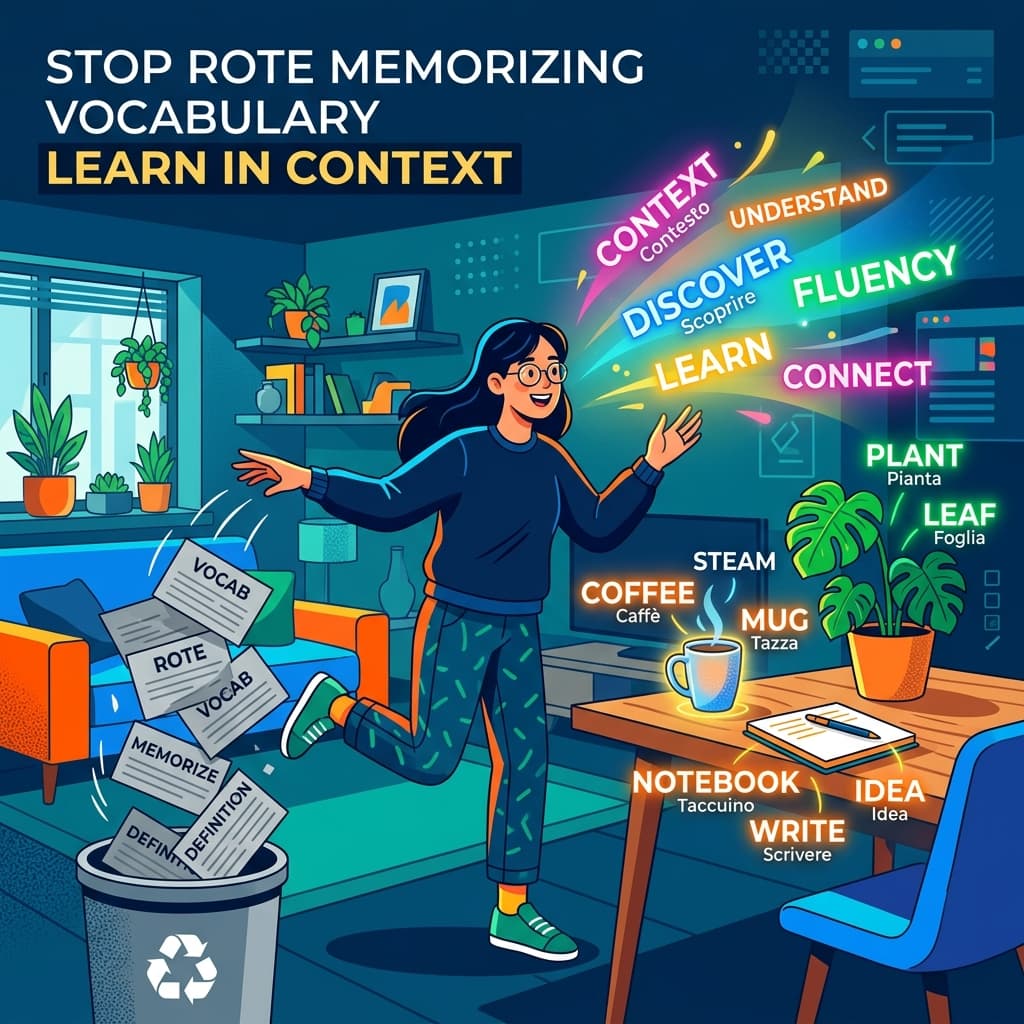
Rote memorization is the practice of repeatedly drilling isolated words until they stick in your short-term memory. While popular, linguists and polyglots widely agree that rote memorization is highly inefficient for language acquisition. Unless you are planning to participate in a spelling bee, memorizing isolated words without context rarely leads to long-term retention or conversational fluency.
Instead, the fastest way to learn vocabulary is through contextual acquisition—learning words through phrases, associations, and practical, everyday usage.
5 Expert Strategies to Learn Vocabulary Quickly
If you want to stop forgetting the words you learn, you need to change your approach. Here are five proven methods recommended by linguists and polyglots for mastering a foreign language.
1. Learn Phrases, Not Isolated Words
Bob Leslie, a Ph.D. in Language and Literature, argues that the most effective way to learn is by memorizing complete phrases rather than single words.
> "An excellent way is to memorise phrases in which the word occurs - that way you can picture the word in context and also learn any particular vocabulary, grammar and syntax associated with it."
>
> — Bob Leslie, Ph.D.
How to apply it: If you want to learn the word "car," don't just write "car" on a flashcard. Write: "I start the car by turning on the ignition with the car key." This embeds the word into a vivid, practical scenario.
2. Limit Your Daily Intake (The 10-15 Rule)
A common mistake beginners make is trying to cram 50 or 100 new words a day. Abdun-Nafay, a polyglot who speaks 15 languages, warns against this overload approach.
> "Keep it slow, learn no more than 10-15 words daily. Practice the learned words in sentences a lot. I did the mistake of trying to only remember the vocabulary. And after I learned 2500 in many months, I found that I can not use them in real sentences."
>
> — Abdun-Nafay
How to apply it: Hard-cap your daily learning. Consistency with 10 words a day (3,650 words a year) is far more effective than burning out after a week of cramming.
3. Build Categorical Word Webs
Cameron Janati emphasizes the power of association. Instead of learning words alphabetically like a dictionary, group them logically.
How to apply it: When you learn the word "Information," create a web of its derivatives and related concepts:
By grouping related terms, your brain forms stronger neural pathways, making the vocabulary much harder to forget.
4. Practice "Inner Monologue" Translation
Linguist Aeishanaya Mishra recommends a practical habit to integrate language into your daily life: framing your everyday actions in your target language.
> "When doing day to day... In your mind try making and framing sentences using verbs and nouns in both your native as well as foreign language."
>
> — Aeishanaya Mishra, Linguist
How to apply it: When opening your refrigerator, think of the word for "fridge." If you don't know it, look it up. This anchors new vocabulary to physical objects and actions in your immediate environment.
5. Adapt to Your Learning Style
Barbara Varinia Galene points out that your approach should match whether you are a Visual, Auditory, or Kinaesthetic learner.
| Learning Style | Recommended Method | How It Works |
|---|---|---|
| Visual | Post-it Notes | Stick notes on objects around your house. Visual cues reinforce memory in context. |
| Auditory | Listen and Repeat | Use audio courses and repeat sentences out loud during commutes or chores. |
| Kinaesthetic | Contextual Action | Review words while performing the action or being in the environment (e.g., learning kitchen words while cooking). |
How Wordrop Enforces Best Practices
Most flashcard apps fail because they encourage rote memorization of isolated words and allow you to take on massive amounts of "Review Debt."
At Wordrop, we built our app to align with these expert principles by design:
- Context First: Words are presented in practical, professional contexts, not isolation.
- Hard Daily Limits: Wordrop strictly limits you to 10 new words per day, preventing burnout and ensuring high-quality retention (just as polyglots recommend).
- Zero Review Debt: If you miss a day, your quota expires. You never open the app to a mountain of overdue cards.
- Ambient Learning: Wordrop surfaces naturally during your workday on macOS, integrating learning seamlessly into your environment without requiring you to schedule dedicated "study time."
👉 Try Wordrop free — Build your vocabulary organically during work, without the burnout.