
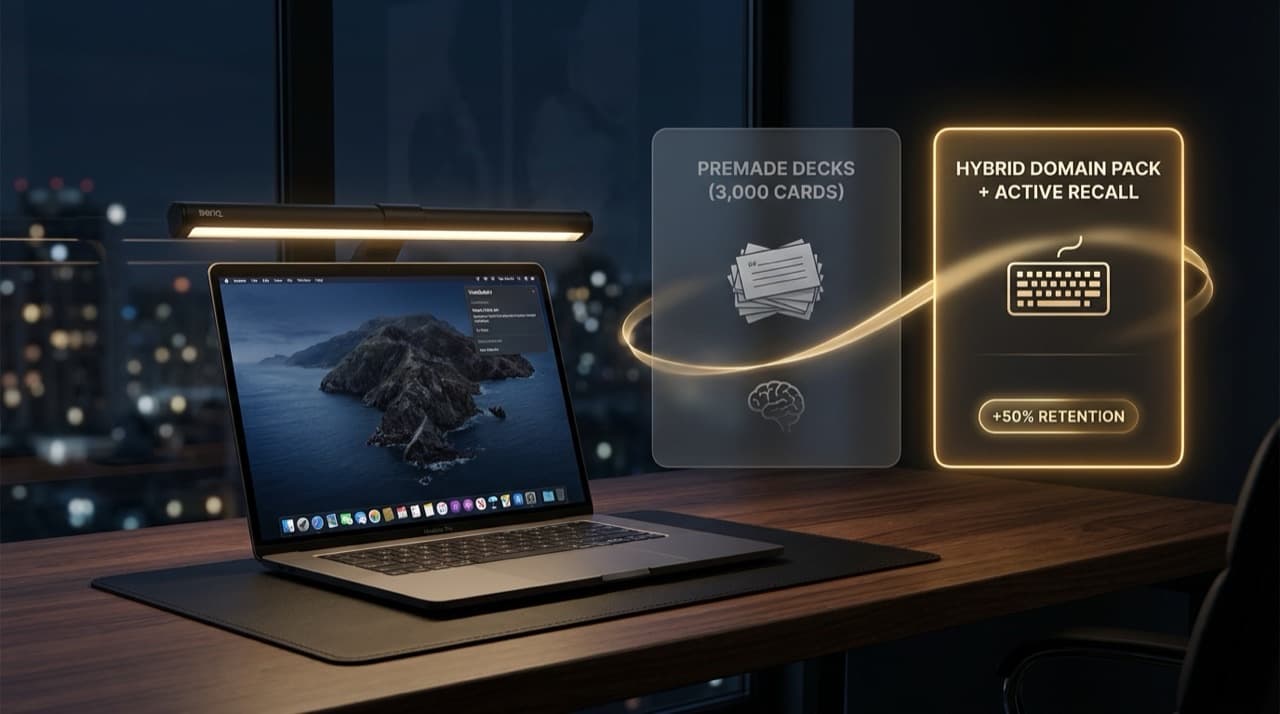
# Make Your Own Anki Decks vs Premade Decks: Which One Actually Works?
Are You Using Anki in a Way That Sets You Up to Fail?
Does this scenario sound familiar?
On a motivated Sunday night, you install Anki. You head straight to AnkiWeb and download a massive shared deck like "3,000 Essential English Words" or "Ultimate Business & IELTS Mega Deck." It takes five seconds to import. Looking at thousands of neatly organized flashcards sitting on your laptop, you breathe a sigh of relief: "Prep work is done. Tomorrow, the grind begins."
Five days later… you dread opening the app. The cards are filled with random words that have nothing to do with your job. You hit Again ten times on the same word, and the next morning your mind still goes blank.
So you pivot to the opposite advice from language forums: Make your own cards so they actually stick.
That evening, after an exhausting eight-hour workday, you open a dictionary. You copy the word, paste the phonetic transcription, hunt for a good example sentence, and format the fields. When you look up at the clock, 45 minutes have vanished — and you have only created 12 cards. Before you can even review a single word, you're too tired to keep your eyes open.
By week two, you quietly close the app. And you never open it again.
You aren't lazy. You don't have a "bad memory." You are simply caught between the two biggest psychological traps in flashcard learning.
Here is the scientific reality most people miss: A landmark study from the University of Toronto (Slamecka & Graf, 1978, Journal of Experimental Psychology) proved that generating information yourself (the Generation Effect) boosts memory retention by up to 50% compared to reading premade material. Yet behavioral research on willpower shows the flip side: when daily setup friction exceeds 15 minutes, over 80% of working professionals quit before day 14 due to cognitive exhaustion (Baumeister et al., 1998).
So should you build your own decks or use premade ones? The real answer will surprise you.
What Are Premade Decks? (And Why They Feel Productive While You Forget Everything)
Premade Decks (Shared Decks) are flashcard collections built and uploaded by someone else. You download them and start reviewing immediately without typing a single word.
Common examples almost every learner has tried:
- The Oxford 3000 or Core 2000/6000 frequency decks
- Free test-prep decks shared on Reddit or Facebook groups
- Massive spreadsheet word lists bulk-converted into Anki cards
- General-purpose decks mixing everything from agriculture to 19th-century literature
The problem isn't that these decks contain wrong definitions. The problem is that your brain gets tricked by the "Collector's Fallacy" and context disconnection.
When you import a 3,000-card deck, your brain gets a hit of dopamine — tricking you into feeling like you already "own" that knowledge.
Then you actually start reviewing. A card pops up with an isolated word and a generic sentence written by a stranger on the other side of the world.
Your brain freezes.
Human memory doesn't store vocabulary like a computer hard drive. It stores words through experiential memory hooks. A word you have never seen in a work email, never read in technical documentation, and never heard in a standup meeting has zero hooks in your brain. When it appears on a stranger's flashcard, it slides right off your memory.
What Are Self-Made Decks? (Why Your Brain Loves Them, But Your Schedule Hates Them)
Self-Made Decks are flashcards you personally curate and type into the app whenever you encounter a useful word in real life.
For example:
- Reading API documentation or a strategy doc, spotting an unfamiliar term → looking it up → turning it into a card
- Hearing a senior colleague use a sharp phrase during a meeting → writing it down → saving the exact sentence on a card
- Getting stuck searching for the right word while drafting an email → finding the exact expression → adding it to your deck
Why does this method create rock-solid retention?
Because the real learning happens before you even start reviewing.
When you pause to look up a definition, judge which meaning fits your current context, and type an example sentence into a card, you force millions of neurons to deeply encode that word. By the time you hit Save, your brain is already halfway to mastering it.
But here is the paradox:
Your brain loves self-made cards. Your full-time work schedule hates them.
Building one high-quality card (with definition, part of speech, context sentence, and audio) takes an average of 2 to 3 minutes. Want 15 new words a day? That costs you 45 minutes of pure data entry every single night.
After eight hours of staring at screens writing code, managing projects, or analyzing data, forcing yourself to do 45 minutes of unpaid clerical work is the fastest road to burnout.
Head-to-Head Comparison: Premade Decks vs Self-Made Decks
| Criteria | Premade Decks (Shared) | Self-Made Decks (Custom) |
|---|---|---|
| How it feels on Day 1 | Fast, effortless, instant thousands of cards | Slow, tedious, heavy setup friction |
| Weekly prep time required | 0 minutes | 3 – 5 hours (just typing and formatting cards) |
| Retention after 1 week | Low (~30–40%, high rate of forgetting) | Very High (~75–85%, strong contextual memory) |
| Relevance to your daily work | Low (cluttered with words you never use) | Maximum (100% tailored to your real life) |
| Why users quit | Nothing sticks, crushing Review Debt | Burnout from endless nightly card creation |
| Core cognitive mechanism | Passive Reception | The Generation Effect (Active Encoding) |
(Retention benchmarks: Slamecka & Graf, 1978; Bertsch et al., 2007, Psychonomic Bulletin & Review)
"The Generation Effect" — The Brain Science Behind the Debate
One of the most replicated findings in cognitive psychology is the Generation Effect:
> Your brain remembers information it actively generates far better than information it passively reads.
In 1978, researchers Norman Slamecka and Peter Graf ran a classic experiment dividing learners into two groups:
- The Read Group: Given complete word pairs printed on cards, such as Rapid — Fast. They simply read and studied the pairs.
- The Generate Group: Given cards with missing letters, such as Rapid — F___. Learners had to actively produce the word Fast themselves.
The results were striking:
Even though the task was simple, the Generate Group remembered 30% to 50% more vocabulary than the Read Group across every single recall test. A later meta-analysis by Bertsch et al. (2007) across 86 studies and over 17,000 participants confirmed the exact same effect.
And here is the critical insight that 90% of Anki users misunderstand:
You do NOT need to spend hours manually typing flashcards from scratch to trigger the Generation Effect.
Copying and pasting dictionary entries into Anki isn't what makes your brain remember. What actually triggers deep encoding is two things:
Why Most Professionals Stay Trapped Between "Hoarding Decks" and "Quitting in Week 2"
Here is the exact cycle software engineers, product managers, and busy professionals go through:
Step 1: You don't have time to make cards, so you download a 3,000-word general English deck.
Step 2: You start studying. Card #1 is about farming. Card #2 is a biology term. Card #3 is an archaic word even native speakers rarely use.
Step 3: Because you have zero personal connection to these words, you flip the card — glance at the meaning — and tap Good just to get through the queue. That is simply passive review disguised as flashcards.
Step 4: A busy deadline hits at work and you miss three days. You open Anki to find 400 overdue cards waiting — and half of them look completely unfamiliar. Overwhelmed, you delete the app.
The way to break this cycle permanently is the 80/20 Hybrid Formula:
Instead of choosing between two broken extremes, combine the best of both:
Domain-Specific Packs + Active Recall + Spaced Repetition = Zero Prep Time, Maximum Retention
Having the right vocabulary list is only the first piece. To turn those words into instant, 2-second reflexes during stakeholder meetings or remote job interviews, you need two scientific engines working together:
- Active Recall: No passive flipping. No multiple-choice guessing. You read the context and meaning → you type out the exact English word letter by letter.
- SM-2 Spaced Repetition: An algorithm that tracks your memory decay and schedules each word right before you are about to forget it (at 1 day, 3 days, 7 days, 14 days...).
When you combine all three:
So Why Do People Still Download Massive 3,000-Word Decks?
Because big numbers create a false sense of security.
Downloading a deck titled "Complete 5,000 Words for English Mastery" feels safer than starting with a focused 450-word professional pack. We are wired to fear missing out.
But in workplace communication and remote interviews, less is more.
Applied linguistics research by Professor Paul Nation (Victoria University of Wellington) shows that within a specialized professional domain, mastering just 400 to 500 core domain-specific words covers over 85% of daily workplace scenarios. Knowing 450 career-relevant words cold is ten times more valuable than hoarding 5,000 generic cards you never finish.
How to Apply the Hybrid Method Today (Without Spending a Minute Making Cards)
You don't need to stay up late building decks or throw away your progress. Make these four simple shifts today:
1. Upgrade how you choose premade decks
❌ Wrong: Downloading bloated, alphabetical mega-decks (Oxford 3000, 5000 Common Words A–Z).
✅ Right: Choosing focused, role-specific vocabulary packs tailored to your immediate career goals (Software Engineering, Product Management, Workplace & Remote Interviews).
2. Ruthlessly skip words you won't use
❌ Wrong: Forcing yourself to memorize every single card in a deck out of guilt.
✅ Right: Asking yourself one question the first time you see a word: "Will I realistically use this in an email, document, or meeting in the next 3 months?" If the answer is no, skip or delete it immediately.
3. Turn premade cards into "Generated" cards with your keyboard
❌ Wrong: Looking at the word → flipping the card to read the definition → clicking Good.
✅ Right: Looking at the definition and cloze sentence → typing the target word out on your keyboard. Typing forces active retrieval and triggers the Generation Effect without requiring you to build the card yourself.
4. Cap your daily intake at 5–10 new words
❌ Wrong: Cramming 50 new cards on a motivated Sunday night.
✅ Right: Locking your daily pace at 5 to 10 new words per day. A sustainable micro-habit lets you master 450 core workplace words in 90 days with zero burnout.
Summary: The Counterintuitive Truth
| If you are... | Your brain is... |
|---|---|
| Downloading a 3,000-word generic deck | Falling for the Collector's Fallacy and forgetting 70% of it |
| Spending 45 minutes a night copy-pasting into Anki | Burning all your mental energy on data entry instead of learning |
| Flipping cards and tapping "Good" | Only building passive recognition — still freezing up in meetings |
| Using focused domain packs + Typing answers on a schedule | Saving 100% of prep time while doubling long-term retention |
How Wordrop Solves the "Custom vs Premade" Dilemma
Wordrop was built specifically for busy professionals who want the proven memory power of Anki without the unpaid part-time job of building flashcards.
1. Zero-Setup Professional Domain Packs:
Instead of dumping 3,000 random words on you, Wordrop gives you curated vocabulary packs locked onto your career (Software Engineering, Product Management, Workplace Communication, IELTS Core) — complete with phonetics, native audio, concise definitions, and real workplace example sentences out of the box. (And if you already have an Anki collection, you can import your existing decks in under 5 minutes).
2. Keyboard-Driven Generation Effect:
No passive card flipping. No multiple-choice crutches. Wordrop requires you to actively type out the vocabulary word from context. Your brain gets the full 50% retention boost of the Generation Effect without spending a single second designing cards.
3. Ambient Delivery on Your Mac Menu Bar:
You never have to remember to open a study app at night. Wordrop lives quietly in your macOS Menu Bar, using natural 30-second micro-breaks during your workday (while code compiles, files export, or between meetings) to serve timely SM-2 spaced repetition quizzes.
Explore Wordrop's zero-prep learning workflow on Mac →
Frequently Asked Questions
Can premade decks ever match the retention of self-made cards?
Yes — under two conditions: the vocabulary must match the real-world context you care about, and you must review using Active Recall (typing or producing the word from memory) rather than passively reading. Cognitive science shows that active retrieval during review is what cements long-term memory, not the clerical act of formatting a card.
What if I already spent months building my own Anki deck?
You don't have to leave it behind! You can export your custom Anki deck and bring it straight into Wordrop by following our 5-minute Anki to Wordrop migration guide.
What if I encounter a great new word while reading docs at work?
That is where the 80/20 Hybrid rule shines. Alongside your prebuilt domain pack (80%), you can click the Wordrop icon right in your Mac Menu Bar to add a custom word (20%) in seconds — without breaking your workflow.
Why does typing the word work so much better than flipping a flashcard?
When you silently flip a card in your head, your brain falls for the fluency illusion — recognizing the answer once it's revealed and pretending you knew it all along. Typing every letter on your keyboard forces complete lexical retrieval, training the exact neural pathway you need when writing emails, Slack messages, or documentation.
How many new words should a busy professional learn per day?
Start with 5 to 10 new words per day following our 90-day workplace vocabulary blueprint. Avoid the temptation to add 30–50 words a day. Small, consistent micro-reviews during work hours always beat weekend cramming sessions.
Conclusion
If you have ever downloaded a dozen Anki decks only to abandon them, or promised yourself you would manually build flashcards every night only to burn out after a week — stop blaming your discipline.
You have a full-time career, not a full-time data-entry job.
Science points to a smarter path: let curated domain packs handle the preparation, let the SM-2 algorithm handle the scheduling, and save 100% of your mental energy for 30 seconds of active recall right inside your daily workflow.
Zero card-making friction. Career-relevant words. Twice the retention.
That is how busy professionals actually master vocabulary.
References: Slamecka, N. J., & Graf, P. (1978), Journal of Experimental Psychology: Human Learning and Memory 4(6); Bertsch, S., Pesta, B. J., Wiscott, R., & McDaniel, M. A. (2007), Psychonomic Bulletin & Review 14(2); Karpicke & Roediger (2008), Science 319; Nation, I. S. P. (2001), Learning Vocabulary in Another Language, Cambridge University Press; Baumeister et al. (1998), Journal of Personality and Social Psychology 74(5).